Sunday, 24 November 2013


...and after a night of blissful dreams with no end
and an abundance of love, comfort, and peace...
she flung open the doors
and discovered the beauty and promise
of another new day ~

She said hello to Sun
and whispered 'thank you' to Moon...
and in loving gratitude
she began her day.

Good Morning, W3 ~
 Kathleen


The Earthly Paradise

"So passed the order of the world again,
Victorious Summer crowning lusty Spring,
Rich Autumn faint with wealth of harvesting,
And Winter the earth's sleep; and then again
Spring, Summer, Autumn and the Winter's pain;
And still and still the same the years went by."

By William Morris
From "The Earthly Paradise"


http://www.thesmartwitch.com/

[Painting: "The Masque of the Four Seasons" (circa 1905) by Walter Crane]


Life & Poetry

SAD TRUTH

There’s one sad truth in life I’ve found
While journeying east and west,
The only folks we really wound,
Are those we love the best
We flatter those we scarcely know,
We please the fleeting guest,
And deal full many a thoughtless blow…
To those who love us best.

“Sad Truth”
By Ella Wheeler Wilcox ©
Life & Poetry 2013

Saturday, 23 November 2013

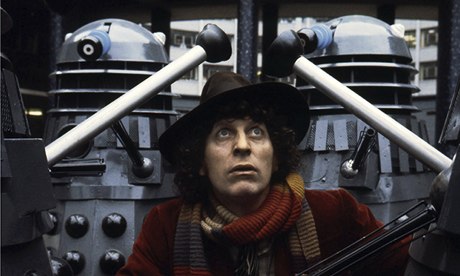
Tom Baker: how I made Doctor Who

Timelord Tom Baker recalls introducing jelly babies to the Doctor's diet, how the Daleks were darlings, and why his scarf kept getting longer
  • The Guardian, 

Tom Baker as Doctor Who
Exuberant … Tom Baker as Doctor Who. Photograph: BBC

Tom Baker, the Doctor

I was an unhappy, out-of-work actor in 1974, working on a building site where they all took the mickey and called me Laurence Olivier. In desperation, I wrote to the BBC just as they were looking to replace Jon Pertwee, who was stepping down as Doctor Who. There were plenty of others in consideration, but when the team behind the programme sawThe Golden Voyage of Sinbad, the Ray Harryhausen film in which I played the magician Koura, that was it.
I didn't consciously try to be different from Jon because I didn't know anything about the series. I was younger, of course – but, having been brought up a Catholic, the idea of disappearing and reappearing, of miraculous events, strange voices and all the other mad things about Doctor Who seemed totally natural to me. Luckily, I got on straight away with my companion Elisabeth Sladen, who played Sarah Jane. She was very influential. The directors didn't always like the things I suggested, like carrying jelly babies, but she thought I was very funny. Because she laughed at what I was doing, the directors noticed and relaxed.
Costume designer Jim Acheson devised my "bohemian look", modelling it on that of a fin-de-siècle student in Paris. The multicoloured scarf came about after Jim bought a wagonload of wool. He gave it to a woman who was so excited at being asked to work for Doctor Who that she started knitting it and just didn't stop. When we went to her room, it was so full of scarf, we couldn't get in. She offered to cut it up, but Jim wanted to keep it. Other designers took over and, with each subsequent series, it got longer and longer and more operatic.
The Daleks were darling chaps. In rehearsals, they used to skim around without the top bits on, holding up their arms in place of the "telescopic manipulators", which were actually sink plungers. That was the only time their faces were seen, so they'd take it very seriously. Often, I'd look over and see the Z Cars boys watching us. They'd be trying not to laugh, yet they all wanted to be in it.
One early adventure, The Sontaran Experiment, was filmed on Dartmoor. While we were shooting the fight scene, I fell and broke my collarbone. Luckily, I had a good stunt double in Terry Walsh, so from that point on I just stood still for closeups and let Terry do the rest. I was always exuberant, but I never overdid the action scenes again.
We'd often have to do retakes because the scenery shook. As an actor, walking through a door naturally is an art, and someone once told me that they'd never seen anyone do it as well as me. I didn't like to say that it was because the BBC sets shook, and the doors had to be closed gently.
Another adventure, The Deadly Assassin, featured a scene in which I almost drowned. It had incurred the wrath of Mary Whitehouse for being so scary, and I was keen to see it when it was transmitted – back then, you couldn't record programmes. I was on a signing tour of the country at the time, and I knocked on the door of a house in Preston, just as a father was settling down to watch it with his two five-year-old sons. He said nothing and just beckoned me inside. I crept into the room and sat quietly in a chair and, as my face came up on screen, you could see the stupefaction on the kids' faces as they noticed me. How could one person be in two places at once? It was just ecstasy. But the whole process of making Doctor Who was a joy.
• The Day of the Doctor, part of the BBC's 50th anniversary celebration of the series, is on BBC1 on 23 November.


What chew doing back there? Playful fox cub risks a telling off from its dad by chomping on his tail

  • Igor Shpilenok photographed the animals in a Russian nature reserve
  • Month-old boisterous cubs push their parents' patience with their games
| 

There's nothing like being cooped up in a den for hours at a time to cause a bit on tension between siblings. 
And these playful month-old fox cubs waste no time in letting off steam with a bit of rough and tumble as soon as they get into the fresh air.
The energetic cubs threw a few punches as they fought with each other while their parents' backs were turned.
Bravery: One of the braver cubs bites off more than it can chew when it clamps its jaws around the tail of its father
Tetchy: These playful cubs let off a little steam while their parents' backs are turned
And one of the cheeky foxes even had the temerity to nip at its father's tail before the adult put it firmly back in its place.
 
The adorable scenes were captured by photographer Igor Shpilenok who had been following the actions of the fox family for months.
He took the pictures in Kronotsky Nature Reserve in Kamchatka - a remote peninsula in the Russian far east.
Rough and tumble: The one month old cubs frolic in Kronotsky Nature Reserve in Kamchatka - a remote peninsula in the Russian far east
He had travelled to the reserve from his home in the west of Russia especially to photograph the wildlife there.
Igor had grown so close to the family, made up of two adults and nine cubs, he nicknamed the father Mr Sneaky Evildoer.
Igor, 52, from Bryansk, Russia, said: 'I nicknamed the male for all his sneaky antics - he stole my clothesline, chewed through my generator cable and made off with my broom.
Enough's enough! The boisterous cub gets firmly put in its place when it finally pushes its father's patience too far
'Foxes are very active and playful, and so are their young. They often play with any 'toys' they can find, like buoys washed up on the shore, sticks, bones or dead animals.
'The young fox was just playing with his father's tail - he apparently found it to be the best toy. He grabbed onto his father's tail and tugged only for a moment and the father ran off.
'The father was quite patient with his offspring, and spent most of his time with them while the mother went off to hunt.'
Igo added: 'It is always a delight to foxes successfully mate, raise their young and survive the harsh winter and other challenges in Kamchatka.'


Read more: http://www.dailymail.co.uk/news/article-2511944/Foxy-Loxy-gets-bit-boxy-Playful-cubs-enjoy-rough-tumble-outing-den.html#ixzz2lVRJkAP6
Follow us: @MailOnline on Twitter | DailyMail on Facebook


Father Christmas and the Fly Agaric magic mushroom of fairy tales

Was Santa Claus inspired by a Magic Mushroom?

The red and white of the traditional clothes that Santa Claus wears matches the colours of the hallucinogenic Fly Agaric fungus, and reindeer eat this truly magical mushroom too. This seemed far too much of a coincidence to ethnobotanist Jonathan Ott who came up with a novel idea to explain the myth of Father Christmas.
Ott suggested that Santa Claus is a direct reference to, and inspired by, the fact that Sami shamans in Lapland and those in Siberia used this magic mushroom for its hallucinatory and intoxicating effects.
Reindeer's urine is even drunk after these animals have eaten Fly Agaric. Of course reindeer and Father Xmas go hand in hand with the idea of him travelling on a sleigh pulled by reindeer. And of course there is the popular Christmas song Rudolph the Red-nosed Reindeer. Once again it is the colour red! I wonder why?

Fly Agaric

Amanita Muscaria by JJ Harrison

Fly Agaric described

The Fly Agaric (Amanita muscaria) is fungus known worldwide because of its usage in illustrations for fairy stories and its association with elves, pixies, gnomes and goblins. This is the toadstool these little folk are pictured sitting on or even living in.
So it is very much associated with a magical world of supernatural beings and faerie folk. It is the toadstool that is always shown in illustrations in fantasy books.
Fly Agaric has a long history of having been used for its hallucinogenic effects by many cultures. The Siberian and Laplander shamans use it and it is thought that it has been employed for its psychoactive effects by many other tribal people and by ancient civilisations.
Some authors such as John Marco Allegro, in his 1970 book The Sacred Mushroom and the Cross, and more recently Chris Everard in Stoneage Psychedelia (2011), have put forward the idea that much of the Bible and Christianity was inspired by the use of this fungus. It is argued that shamans and priests of these ancient cultures took magic mushrooms to get in touch with the spirit world and that the Fly Agaric was behind a mushroom cult as well as an important and valuable item that could be traded by merchants at the time.
Clark Heinrich, in Magic Mushrooms in Religion and Alchemy (2002), identifies the Fly Agaric as having been eaten by Adam and Eve and as having been behind the visions of many of the prophets of the Old Testament.
R, Gordon Wasson suggested in Soma:Divine Mushroom of Immortality (1967) that the Fly Agaric was the "Soma" of the Hindu Vedic scriptures.
These authors have argued that much of the world's religions were inspired and written by users of the Fly Agaric, as well as other hallucinogenic plants. Naturally these theories have not gone down well in some circles and arguments debunking these opinions have also been launched. Nevertheless the Fly Agaric does appear in much religious artwork, does produce visions and an altered reality or "spirit world" and definitely has been used for its effects by some tribal shamans.
Fly Agaric is often described in books about fungi as poisonous. This may be because it causes delirium and hallucinations, though it is known to produce other harmful symptoms including vomiting and nausea. Seizures and coma have resulted from high dosage poisonings.
The fungus varies in the amounts of the toxins present in it and reactions are different in different people. The dried fungus is said to be much less toxic than when fresh. It is said to be detoxified by boiling and has actually been regarded as a food in some places such as Japan.
The psychoactive effects of the Fly Agaric are caused by the substances muscimol and ibotenic acid. It is not a psychedelic drug like Psilocybin magic mushrooms but acts as a deleriant. Because Magic Mushrooms have been made an illegal drug in many countries including the UK, more recreational drug-users and neo-shamans have switched to taking Fly Agaric. It is often sold by companies that deal in etheogens and legal highs and is even available on eBay.
Fly Agaric grows in groups under pine and birch and other trees and is found in late summer and autumn in most of its range. The fungus has been accidentally introduced to many countries where it didn't grow before and is now found in most parts of the world.
Fly Agaric also comes in other colour varieties including yellow, orange and brown.

Magic mushrooms & Reindeer - Weird Nature - BBC animals

Superhuman strength

Fly Agaric is certainly a very colourful wild mushroom that has inspired an incredible amount of artwork, writings and debate, though whether it was really behind Santa Claus and his red and white suit is impossible to say.
It is said that one of the effects of intoxication with Fly Agaric is almost superhuman strength and energy. According to Wikipedia, the Koryak of eastern Siberia have a folk-tale about the Fly Agaric ("Wapaq" ) which was said to have allowed Big Raven to carry a whale to its home. Father Christmas would need that sort of superhuman power to do all the work he gets through on Christmas Eve!

Copyright © 2011 Steve Andrews. All Rights Reserved.