Monday, 31 October 2016

AbeBooks' Most Expensive Sales

Two Alices, two Waughs, and two Brontës can be found on this list of AbeBooks' most expensive sales that features several famous books from famous names. However, the complete print run of The British Gazette newspaper, all eight issues, stands out as a remarkable slice of paper-based ephemera that has now lasted 90 years.
1. Alice's Adventures in Wonderland by Lewis Carroll - £27,500

Only 22 copies of the true first edition are in existence after Lewis Carroll withdrew the entire print run of 2,000 copies. One such copy came up for auction earlier in 2016 and was expected to sell for between $2 million and $3 million, but it failed to meet its reserve and didn't sell. This copy that sold via AbeBooks was one of the first thousand copies printed for the American market. Bound in its original red cloth, this book was housed in a red morocco case created by famed bookbinders Sangorski & Sutcliffe. The publisher is Appleton of New York and the publication date is 1866.
2. A Handful of Dust by Evelyn Waugh - £13,450

Published by Chapman & Hall in 1934, this first edition was inscribed by the author, "Best love from Evelyn to Bertie & Diane." A Handful of Dust is a satire but with serious themes. The story details the misfortunes of Tony Last, a shallow English country squire who joins a Brazilian jungle expedition. The plot is particularly autobiographical and reflects Waugh's desertion of his own wife and his travels to South America.
3. To Kill a Mockingbird by Harper Lee - £13,080
A signed first edition of this classic from 1960 in fine condition with a price clipped dust jacket. Harper Lee died in February 2016. The most expensive copy of this book ever sold on AbeBooks went for £25,000 in May 2011.
First editions of Flappers and Philosophers, The Beautiful and Damned, Tales Of The Jazz Age, The Great Gatsby, All The Sad Young Men, and Tender Is The Night - all with facsimile dust jackets. The set also included a number of works about the author and his wife Zelda.
5. The British Gazette (issues 1-8) - £8,030

The British Gazette was a short-lived newspaper published by the Government during the 1926 General Strike. Printers were among the first workers to strike so newspapers were severely restricted. Issues one to eight is the complete run of the paper, which Winston Churchill, while chancellor of the exchequer, edited. Signed by Churchill, and fellow politicians Stanley Baldwin and J.C.C. Davidson. This sale consisted of eight double-sided broadsheets and Churchill's original handwritten notice (pictured above) to the Press announcing the termination of the strike.
6. Great Books of the Western World (96 vols) - £7,990
The Franklin Press' 25th anniversary edition from 1970 of this epic collection of classic books from Homer and Plato to Darwin and Tolstoy.
7. Brideshead Revisited by Evelyn Waugh - £7,945
A copy of the first US edition, first printing from 1945, inscribed by Waugh "Henie Peters, with love from, Evelyn 1946." Henie Peters was the wife of Waugh's agent A.D. Peters. Waugh's opinion of his own book cooled over the years, but in 1998 the Modern Library ranked Brideshead Revisited on its top 100 list of the best English-language novels of the 20th century.
8. Alice's Adventures in Wonderland illustrated by Salvador Dali - £7,766

The 1969 limited edition signed by Dali, who supplied 12 surreal illustrations. New York's Maecenas Press-Random House distributed this edition as their book of the month and it has been sought-after by collectors ever since. In 2015, Princeton University Press issued a 150th anniversary reprint edition and now we can all enjoy Dali's work without paying £9,500.
9. Wuthering Heights and Agnes Grey by Emily Brontë & Anne Brontë respectively - £7,381
Two works in one volume. Second edition from December 1850 but the title date of a large number of copies was altered to 1851. This edition contains Charlotte Brontë's 'Biographical Notice' of her two sisters with a preface to Wuthering Heights, and a series of poems by Emily and Anne which appeared for the first time.
10. Sports et Divertissements (Sports and Pastimes) by Erik Satie - £7,215

This is a rare collector's album with beautiful Art Deco illustrations by Charles Martin of Satie's cycle of 21 short piano pieces composed in 1914.

Sunday, 30 October 2016

27 Interesting Facts About Diwali

“Diwali,” which is also referred to as Deepavali and Divali, is an important festival in India that is mainly celebrated by the Hindus. It is also known as the festival of light. Every year, the date of this festival is calculated by the Hindu lunar calendar. In 2015, the festival was celebrated on November 11th, and it will be held on October 30th in 2016.

Here are 27 interesting facts about Diwali

1. Diwali is celebrated on the fifteenth day of the Hindu month of Kartika. Hinduism is a major religion of India, and is considered to be the oldest religion in the world.
2. More than 800 million people celebrate this festival in various ways.
3. It is celebrated in honor of Lakshmi – the Hindu goddess of wealth and prosperity.
4. The festival also marks the return of the Lord Rama and Sita after completing fourteen years in exile.
5. The word Diwali means “the row of lighted lamps (diyas)” in Hindi.
6. The festival signifies the victory of light over darkness.
7. Diwali also marks a major shopping festival in the places where it is celebrated. There are special discounts and offers that businesses provide to their customers. Buying new things during this festival is considered to be good.
8. It is the most famous, biggest and brightest festival of India, and is celebrated for five days.
9. It is a national holiday in India, Trinidad & Tobago, Myanmar, Nepal, Mauritius, Guyana, Singapore, Surinam, Malaysia, Sri Lanka and Fiji. And is an optional holiday in Pakistan.
10. On the same night that Diwali is celebrated, Jains celebrate a festival of lights to mark the attainment of moksha by Mahavira.
11. Oil and light lamps are used in high numbers in and around peoples’ houses and properties to celebrate the festival. The festival commemorates the lighting that was done to bring Lord Rama and his wife Sita from the forest of Ayodhya.
12. Diyas light the houses; fireworks illuminate the skies and rangoli decoratesthe outside Hindu homes. They do this to attract Lakshmi, the goddess of good fortune.
Rangoli! Decoration
Rangoli! Decoration. Image credit – Deepak Kumaran
A statue of Lord Ganesha
A statue of Lord Ganesha. Image credit – myriad ways
13. Traditional diyas (light lamps) used during Diwali are earthen lamps, although plastic and metallic diyas have also become available recently. These diyas are filled with ghee or oil, and a cotton wick is used to bear the flame.
14. And the diyas are left burning all night.
15. Sikhs also celebrate Diwali, as it marks the release of their gurji – Guru Hargobind Sahibji – and 52 other kings and princess of India that were made captives by the mogul emperor Shah Jahan.
16. It is a tradition to clean the house, making it spotless before entering the New Year.
17. Businesses also start new accounting books, and farmers end the harvest season. The festival also signals the onset of winter.
Kali the Goddess
Kali the Goddess. Image credit – Vinoth Chandar
18. Hindus all over the world, and especially in India celebrate the festival by exchanging gifts, wearing new clothes and preparing festive meals.
19. Idols of Lord Ganesh and Goddess Lakshmi are placed side by side for the prayers and rituals. Lord Ganesh is worshipped first followed by Lord Lakshmi.
20. Diwali is also celebrated in honor of the marriage of the Lord Vishnu and Goddess Lakshmi. And it also marks the triumph of the Lord Krishna over the demon Naraka. Hindus in Bengal honor the fearsome Goddess Kali on the occasion of Diwali.
21. The English city of Leicester hosts the biggest Diwali celebrations outside of India.
22. Diwali also plays a significant role in Sikhism. The foundation stone of the Golden Temple was laid on the day of Diwali in 1577.
23. “Shubh Deepavali” is a customary greeting associated with Diwali. It means, “Have an auspicious diwali”.
24. During the festival of Diwali, fireworks worth billions of dollars are ignited. These fireworks cause a lot of pollution, which is a particularly life hazard for those living in densely populated areas such as the cities of New Delhi, Mumbai, Kolkata and Chennai in India. Fireworks produce a variety of pollutants affecting sound, light, air and water.
25. These fireworks cause health hazards such as respiratory issues, heart attacks, high blood pressure and many more. Moreover, fireworks during Diwali also cause safety hazards to the children handling them. Many of these firecrackers burst near children, causing them direct injuries. Hence, necessary precautions must be taken during the festival season, and a more environmentally friendly way of celebrating the festival should be adopted in the coming years.
26. Electricity consumption also rises significantly during the festival season, which results in heavy use of diesel generators to meet the demand for power. In turn, more pollution is caused due to the burning of fossil fuels.
27. The total cost of the firecrackers exploded in Diwali is estimated to be around one billion dollars. This is a significant amount of money, which could be used for other purposes like providing education and better health care facilities to those individuals who need them.
References:

8 of the oldest forests in the world

Tongass

credit: Zarxos
With trees dating as far back as Stonehenge and the Egyptian pyramids, these majestic old forests are living shrines to the ancient past.
I love people, but we sure are an arrogant species – we think we're better than trees, but if trees could laugh at us, they probably would (between curses, of course). We may not be rooted to one place and sure, we have opposable thumbs with which to operate our smartphones, but trees have the thing we covet most and will never have – mind-boggling longevity! The forests on the following pages play home to some of the oldest living things on the planet, some dating back almost 5,000 years. Respect to the trees, they win.

1. Tongass National Forest: Alaska


At a whopping 16.8 million acres, this temperate rain forest, pictured above, is almost as big as Vermont, New Hampshire and Massachusetts combined! This qualifies Tongass as the largest national forest in America, as well as largest intact coastal temperate rain forest in the world.
Parts of the forest are estimated to be thousands of years old, with many living trees over 800 years old. National Geographic describes Tongass as an "exceptionally rich ecosystem that holds more organic matter—more biomass—per acre than any other, including tropical jungles. And that's not counting the equally lush forests of seaweed added to Tongass shores whenever the tide goes out."
As Tongass represents nearly a third of all old-growth temperate rainforests remaining on the planet, it also plays home to a staggering array of fish and wildlife, including all five species of Pacific salmon, grizzly bears, wolves, Sitka black-tailed deer, Northern Goshawks, and marbled Murrelets.


Friday, 28 October 2016

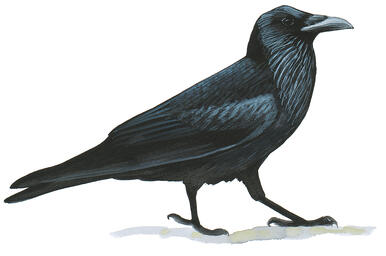
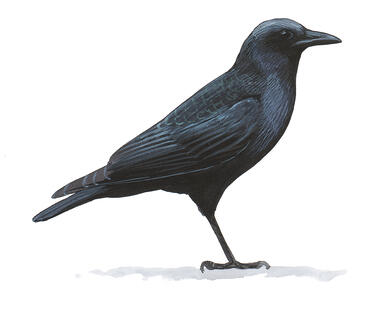
How to Tell a Raven From a Crow

These black birds may look similar in some ways, but several distinctive traits help set them apart.

Go here to hear the podcast
This story comes to you through a partnership between Audubon and BirdNote, a show that airs daily on public radio stations nationwide.
You’re outside, enjoying a sunny day when a shadow at your feet causes you to look up.  A large, black bird flies over and lands in a nearby tree. You wonder: is that a crow or a raven?

These two species, Common Ravens and American Crows, overlap widely throughout North America, and they look quite similar. But with a bit of practice, you can tell them apart.
You probably know that ravens are larger, the size of a Red-tailed Hawk. Ravens often travel in pairs, while crows are seen in larger groups. Also, watch the bird’s tail as it flies overhead. The crow’s tail feathers are basically the same length, so when the bird spreads its tail, it opens like a fan. Ravens, however, have longer middle feathers in their tails, so their tail appears wedge-shaped when open.
Listen closely to the birds’ calls. Crows give a cawing sound. But ravens produce a lower croaking sound. 
We’re back looking up at that tree. Now can you tell? Is this an American Crow or a Common Raven?
That’s a raven. The bird calls you hear on BirdNote come from the Macaulay Library at the Cornell Lab of Ornithology. To hear them again, begin with a visit to our website, BirdNote.org. I’m Michael Stein.
American Crow. Photo: Brian Kushner
Adapted by Dennis Paulson from a script written by Frances Wood.
Calls provided by The Macaulay Library of Natural Sounds at the Cornell Lab of Ornithology, Ithaca, New York. Ambient track American Raven recorded by R.S. Little, American Crow recorded by G.A. Keller.
Forest ambient and featured raven recorded by C. Peterson
Producer: John Kessler
Executive Producer: Chris Peterson
© 2012 Tune In to Nature.org     September 2012     Narrator: Michael Stein

Tuesday, 25 October 2016

CREAMY THREE BEAN STEW

Creamy three bean stew - healthy comfort food! This stew is totally vegetarian, but is still really high in protein, and the sauce is really rich and creamy. So yum!

CREAMY THREE BEAN STEW
Author: Prep time
Cook time
Total time
 
Recipe type: Main meal
Yield: Serves 3-4
INGREDIENTS
  • 1 tbsp oil
  • 1 onion, sliced or diced
  • 2 carrots, diced
  • 3 cloves garlic, minced
  • 1 medium courgette (zucchini), diced
  • 4 medium mushrooms, diced
  • 400g tin cannellini beans, drained (240g, or ~ 1¼ cups, when drained)
  • 400g tin black beans, drained (240g, or ~ 1¼ cups, when drained)
  • 400g tin kidney beans, drained (240g, or ~ 1¼ cups, when drained)
  • 400g (~ 1⅓ cups) tinned tomatoes
  • 400g tin cream of tomato soup (~ 1⅓ cups)
  • 150ml (~ ½ cup) water
  • 1 vegetable stock cube, crumbled
  • 1 tsp dried oregano
  • Salt
  • Black pepper
  • Small bunch fresh parsley, chopped
  • 3 tbsp creme fraiche (I used half fat) or cream cheese
INSTRUCTIONS
  1. Heat 1 tbsp oil in a large saucepan, and add the diced onion and carrot. Cook over a medium heat for a few minutes, stirring regularly, until the onion has softened slightly. Add the garlic, courgette and mushrooms, and cook for a further 5 minutes, until the vegetables are fairly soft.
  2. Add the three tins of beans, tin of tomatoes, tomato soup, water and crumbled stock cube. Also add the oregano, and season to taste. Bring to a simmer. and cook for around 20-30 minutes, stirring occasionally, until the liquid has reduced to produce a thick sauce. Add the parsley and creme fraiche, mix to combine, and serve warm.


Saturday, 22 October 2016

Black Bean 'n' Pumpkin Chili Recipe

Black Bean 'n' Pumpkin Chili Recipe

TOTAL TIME: Prep: 20 min. Cook: 4 hours
MAKES: 10 servings

Ingredients

  • 2 tablespoons olive oil
  • 1 medium onion, chopped
  • 1 medium sweet yellow pepper, chopped
  • 3 garlic cloves, minced
  • 2 cans (15 ounces each) black beans, rinsed and drained
  • 1 can (15 ounces) solid-pack pumpkin
  • 1 can (14-1/2 ounces) diced tomatoes, undrained
  • 3 cups chicken broth
  • 2-1/2 cups cubed cooked turkey
  • 2 teaspoons dried parsley flakes
  • 2 teaspoons chili powder
  • 1-1/2 teaspoons ground cumin
  • 1-1/2 teaspoons dried oregano
  • 1/2 teaspoon salt
  • Cubed avocado and thinly sliced green onions, optional

Directions

  1. In a large skillet, heat oil over medium-high heat. Add onion and pepper; cook and stir until tender. Add garlic; cook 1 minute longer.
  2. Transfer to a 5-qt. slow cooker; stir in the next 10 ingredients. Cook, covered, on low 4-5 hours. If desired, top with avocado and green onions. Yield: 10 servings (2-1/2 quarts).