Friday, 25 August 2017

A Story on a Plate: The Ladies of Llangollen

A Story on a Plate

Take for example a plate in the collections of Amgueddfa Cymru National Museum Wales, which features an image of two women on horseback set within a landscape. It is just one in thousands of blue and white transfer printed wares so popular in the 19th century and beyond. However this picture is intriguing.
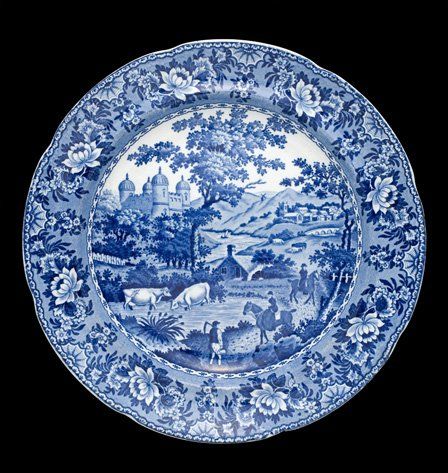
Plate, Glamorgan Pottery, c. 1813-1839
It is called “Ladies of Llangollen” inspired by the story of two women, Lady Eleanor Butler and Miss Sarah Ponsonby.
When Eleanor and Sarah developed a passion for each other in their native Ireland their families, alarmed by this same-sex attraction, tried to ban them from seeing each other. However, determined to be together, they made an escape in the dead of night but were quickly captured. Persistently Eleanor and Sarah fought for the right to be together until eventually they won and their families allowed them to leave.
They made their way to Wales and eventually set up home in a small cottage in Llangollen where they were to live together for over 50 years.

Growing Fame

Their fame quickly grew and were visited by and corresponded with all manner of people such as Shelley, Byron, Sir Walter Scott, the Duke of Wellington, Josiah Wedgewood and Caroline Lamb. Their deaths in 1829 and 1831, respectively, did not end the fascination with this couple and throughout the following centuries their fame has endured - making them probably the most famous lesbian couple in history.
During their lifetimes, the Ladies were adamant they wanted no portraits done.
However when Lady Parker visited in 1829 she got her mother to distract Eleanor and Sarah whilst she made quick sketches of their faces under the table. Eleanor was now quite blind so Lady Parker was able to sketch her full face whilst Sarah is in profile. After the couple’s deaths she worked the faces up into full body poses set within their library and sold copies of the picture to raise money for charity.
Portrait of Lady Eleanor Butler and Sarah Ponsonby, worked from a clandestine sketch made at their Llangollen home.

A Stolen Portrait

Around 1830 James Henry Lynch pirated the picture and produced what was to become the most enduring image of Eleanor and Sarah. It was mass produced and featured on a large range of tourist souvenirs, postcards and the covers of many books.
The 'Lynch' portrait of Lady Eleanor Butler and Sarah Ponsonby, pirated from the earlier 'Library' portrait and distributed on a mass scale.
The picture Lynch produced was of the two women standing outside dressed in riding habits which both women were known to favour. And it appears at the tail end of a period of public fascination with Eleanor and Sarah’s lives.
The story of the Ladies had reached a wide audience by the late 18th-early 19th century and numerous accounts of their lives were being produced. Even William Wordsworth wrote a poem in 1824 after visiting them. Therefore interest was high when the pottery designs started appearing.

Glamorgan Pottery and the History of the 'Llangollen' plate

The first design shows the women on horseback talking to a man carrying a scythe over his shoulder with some cattle, the town of Llangollen, the River Dee and a highly imaginative Castell Dinas Bran in the background.
'Ladies of Llangollen' blue pattern plate marked with 'BBI' stamp
The earliest date for the design is via a base stamp ‘BB&I’. This refers to Baker, Bevin and Irwin of Glamorgan Pottery and was used c. 1815-25. It went on to become one of Glamorgan Pottery’s most famous pieces and means that the plate was produced during the lifetime of both Eleanor and Sarah. The two women, both avid diary keepers, made no comment so we don’t know if they knew of the plates or if they approved of being fictionalised.
Glamorgan pottery was then taken over by Swansea businessman Lewis Llewelyn Dillwyn in 1838 and he continued to produce the design using the Glamorgan, Swansea and Cambrian stamps until around 1840. However it is likely that he was already using the same design at the Cambrian Pottery from around 1825, as there was rivalry between the two potteries and they did use some of the same designs.[1]
The fascinating link here is that the most famous member of Lewis’ family was Amy Dillwyn. Amy, a business woman, ran her father’s spelter works after his death, was also a well-known novelist.
She too was in a same sex relationship. It would be nice to have a flight of fancy and think that Amy, having seen the Glamorgan plate, had some influence in getting her brother to produce it at the Cambrian Pottery but there is no evidence of her involvement.
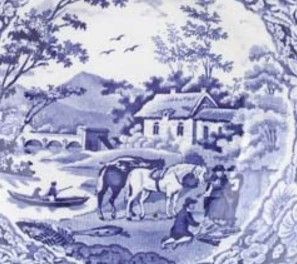
Detail of blue plate showing an illustration of Sarah Ponsonby and Eleanor Butler © Norena Shopland
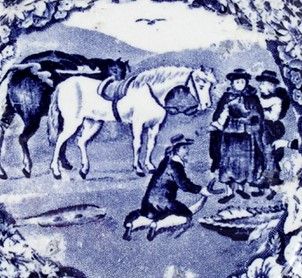
It is not clear whether it was the Glamorgan pottery design which was produced first or another by William Adams of Stoke. This design, also called Ladies of Llangollen, features the two women, again in riding habits, standing looking down at a man who appears to be showing them a large fish. Behind them stand their horses whilst in the distance there are two men in a boat, one punting along, a bridge and on the bank a rustic cottage. The mountain Cadair Berwyn is in the centre.
Adams had produced a pottery series called ‘Native’ in the 1820s and this design was part of that series. Not long after F. and R. Pratt of Fenton, Staffordshire acquired the plates from Adams and reproduced the series between 1880 and 1920 renaming it ‘Pratt’s Native Scenery.’ When Cauldon took over Pratt’s in the 1920s they continued using the design up to c1930s.
There continues to be enormous interest in Eleanor and Sarah - particularly when discussing how we define lesbian relationships from the past. However despite the mass of interest these fictionalised blue and white images are hardly ever mentioned. But at least we know that Amgueddfa Cymru - National Museum Wales have this piece in their LGBT collection.

NORENA SHOPLAND
Author of Forbidden Lives: LGBT stories from Wales to be published by Seren Books, 17th October 2017
 

“His master’s voice” – The origins of the famous Jack Russell terrier, Nipper, the canine advertising icon for many gramophone companies

One of the most famous late 19th and early 20th-century advertising icons was, apparently, a Jack Russell terrier, the very same one who was a model for a painting called “His Master’s Voice.”
The image was the foundation of the logo for many gramophone and recording brands like HMV, EMI, RCA, Victor Talking Machine Company, and more. The curious dog which looks and listens to the gramophone goes by the name of Nipper.
Francis Barraud’s original painting of Nipper (1884–1895), looking into an Edison Bell cylinder phonograph.
Nipper (1884–1895) was born in Bristol, England, and was a mixed-breed Jack Russell Terrier. The playful dog’s tendency to bite the backs of visitors legs earned him the name.
The Jack Russell Terrier died from natural causes and was buried in Clarence Street, Kingston, near the Thames. His grave is in a small park full of magnolia trees.
When Nipper’s first master, scenery designer Mark Henry Barraud, died penniless in Bristol in 1887, Mark’s younger brothers, Francis and Phillip Barraud, took care of Nipper in Liverpool. The aspiring painter, Francis, sparked the hilarious idea of painting Nipper on canvas, depicting him absolutely confounded and wondering how the sounds could be coming out of the unusual object.
Francis Barraud painting Nipper. In Liverpool, Barraud noticed how Nipper often curiously examined the phonograph (the cylinder record player) that they had at home. The little dog was puzzled by where the voice came from, and Barraud found it very amusing.
“It certainly was the happiest thought I ever had,” says Francis, commenting on how entertaining it was to watch Nipper stare and listen to the phonograph. The scene was, no doubt, inscribed in Barraud’s mind that even three years after Nipper’s death, he was determined to paint the little dog on canvas.
After he had finished the painting on 11th February 1898, which honored Nipper’s natural curiosity, Barraud thought to himself that maybe the Edison-Bell phonograph company would find his work useful. Sadly, the company turned down Barraud’s offer, skeptically stating “Dogs don’t listen to phonographs.”
A refurbished edition of the painting. Barraud kept painting and restoring a total of 24 replicas throughout his life. Following Barraud’s death in 1924, many other artists carried on the tradition.
Barraud named the painting “Dog looking at and listening to a Phonograph,” and eventually he decided to rename it to “His Master’s Voice.” At one point, he tried his luck exhibiting it at the Royal Academy, but without success. “No one would know what the dog was doing,” complained many advertising companies and clients.
1910 Deutsche Grammophon logo on Swedish disc Photo Credit
Finally, on May 31st, 1899, luck smiled upon Barraud. When he went to borrow a brass horn to replace the black one on the painting from the Maiden Lane offices of The Gramophone Company, a manager of the company, Barry Owen, suggested replacing the phonograph with a Berliner disc gramophone, and then the company would buy the painting.
The painting would become a highly successful trademark of the Victor, HMV, and its many branch companies, as a registered trademark on July 10th, 1900.
For many years, the original oil painting was in Hayes, Middlesex, on a wall in the EMI boardroom.
Famous opera singer, Enrico Caruso, with a customized Victrola given to him as a wedding gift by the Victor Company in 1918.
The slogan “His Master’s Voice,” along with the painting, were sold to The Gramophone Company for 100 pounds; 50 pounds for the slogan, and 50 pounds for the painting itself.
1921 Victor Talking Machine company advertisement.
“It is difficult to say how the idea came to me beyond the fact that it suddenly occurred to me that to have my dog listening to the phonograph, with an intelligent and rather puzzled expression, and call it ‘His Master’s Voice’ would make an excellent subject,” stated Barraud.
The painting’s first advertising debut was in January 1900, on the Gramophone Company’s advertising literature. However, “His Master’s Voice” did not feature on the Company’s British letter headings until 1907. The painting and title were finally registered as a trademark in 1910.
Oddly enough, there have been slight mishaps and revoking requests which led to the brand’s label as null and void. Emile Berliner, the highly successful inventor of the gramophone, asked permission of the slogan’s copyright from Barry Owen, the man who accepted Barraud’s request.
Emile Berliner (May 20, 1851 – August 3, 1929), German-born American inventor, best known for inventing the flat disc phonograph record and the Gramophone. He founded the United States Gramophone Company in 1894.
EMI paid the price of the careless legal handling and lost the trademark’s rights. Eighty years later, with the grand arrival of the CD, which forced the companies to start central manufacturing throughout the world, EMI Classics gained the position as the main “heir” to the “His Master’s Voice” slogan.
Today, the “His Master’s Voice” trademark is only used by EMI as a marketing brand for HMV Shops. Nevertheless, it is still recognized by many and remains in the Top 10 of “Famous Brands of the 20th Century”.
As for Nipper, although he was definitely not a purebred, he never hesitated to take on another dog in a fight. With undying vigor and enthusiasm, he loved chasing mice and pheasants in the local park. Nipper Alley, a road near Nipper’s final resting place in Kingston, was named in his honor on 10th March 2010 to commemorate his ever-curious look of wonder.


The City of Literature: 40 Books Set in Paris

Hemingway wrote, "If you are lucky enough to have lived in Paris as a young man, then wherever you go for the rest of your life, it stays with you, for Paris is a moveable feast."
It's a book lover's dream to wander the very streets that inspired Marcel Proust, Ã‰mile Zola, Samuel Beckett, Albert Camus, Sartre, Simone de Beauvoir and so many others. You might step into the Salon at 27 rue de Fleurus where Gertrude Stein mentored Ernest Hemingway, or have a drink at the café littéraires Les Deux Magots and Café de Flore, the long-ago haunts of James Joyce, F. Scott Fitzgerald, Ezra Pound and their fellow The Lost Generation writers.
The love affair between Paris and writers has been a long and passionate one, whether authors are writing from Paris or about it. For centuries, the city has been host to an array of love stories, murder mysteries and dramas, from timeless tales like Victor Hugo's The Hunchback of Notre Dame to ground-breaking modern literature like Henry Miller's Tropic of Cancer.
The astounding effect of Paris on writers is demonstrated in the countless memoirs they have penned about their days, years and lives spent in the city. The effect is so strong it's even inspired chefs and bakers to put down their whisks and pick up their pens, giving food memoirs a genre all of their own.
What is it about Paris that's so attractive to the creatively-inclined? Perhaps the city's own history is the most interesting story of them all. Take a literary tour with our selection of novels set in Paris, memoirs about life in Paris and Paris history books.

Novels Set in Paris

The Nightingale by Kristin HannahThe Nightingale
Kristin Hannah
   
Paris Was the Place by Susan ConleyParis Was the Place
Susan Conley
 
Hunting and Gathering by Anna GavaldaHunting and Gathering
Anna Gavalda
 
Sarah's Key by Tatiana de RosnaySarah's Key
Tatiana de Rosnay
   
Giovanni's Room by James BaldwinGiovanni's Room
James Baldwin
 
The Razor's Edge by W Somerset MaughamThe Razor's Edge
W Somerset Maugham
 
Leon and Louise by Alex CapusLeon and Louise
Alex Capus
 
Cheri by ColetteCheri
Colette
 
The Ambassadors by Henry JamesThe Ambassadors
Henry James
 
The Paris Architect by Charles BelfoureThe Paris Architect
Charles Belfoure
 
Tropic of Cancer by Henry MillerTropic of Cancer
Henry Miller
 
The Paris Wife by Paula McLainThe Paris Wife
Paula McLain
 
Paris by Edward RutherfurdParis
Edward Rutherfurd
 
The Sun Also Rises by Ernest HemingwayThe Sun Also Rises
Ernest Hemingway

Memoirs About Life in Paris

     
That Summer in Paris by Morley CallaghanThat Summer in Paris
Morley Callaghan
Paris to the Moon by Adam GopnikParis to the Moon
Adam Gopnik
 
The Hare With Amber Eyes by Edmund de WaalThe Hare With Amber Eyes
Edmund de Waal
     
Paris, France by Gertrude SteinParis, France
Gertrude Stein
 
My Life in France by Julia ChildMy Life in France
Julia Child
 
A Moveable Feast by Ernest HemingwayA Moveable Feast
Ernest Hemingway

Paris History Books

       
Seven Ages of Paris by Alistair HorneSeven Ages of Paris
Alistair Horne