"What if you were wrong? What if everything you ever believed was a lie? What if you missed your opportunity because you didn't know your worth? What if you settled on familiar, but God was trying to give you something better? What if you decided not to go backwards, but forward? What if doing what you have never done before was the answer to everything that didn't make sense? What if the answer wasn't to be found in words, but in action? What if you found the courage to do what you really wanted to do and doing it changed your whole life?"
~ Shannon L. Alder
"What if you just did it your own way? No rules, no right or wrong, just what you think is beautiful?"
~ Sandra Magsamen
Turn your "what ifs" into "what is". Have a happy Saturday!
What music is to the heart, mathematics is to the mind.
- Amit Kalantri,
Wealth of Words
[Image: Le Note Finali (The Final Note)(2021) oil painting on canvas by contemporary Italian artist Sergio Cerchi, known for a unique style often called "quadrantism," where the pictorial surface is fractured and multiplied, akin to a musical staff.]
From wagging tails to expressive eyebrows, dogs already have plenty of ways of making their emotions known to humans.
But scientists have found another surprising way they could be trying to tell you something important - by blinking.
A study has discovered that dogs use blinking as a 'subtle affiliative signal' when they look at people they are close to.
That means your pet's fluttering lashes could be them trying to communicate friendliness or build a closer social bond with you.
In the study, scientists from the University of Parma, Italy, discovered that dogs started blinking faster when they saw a human blinking, compared with when they saw footage of someone staring.
However, the effect only kicked in if the person in the video was their owner.
Lead author Dr Chiara Canori told the Daily Mail: 'I believe that it suggests that dog-human communication may be more subtle and responsive to social relationships than we actually recognise.
'There may be a much richer layer of communication in these small, overlooked changes in behaviour, and learning to recognise and acknowledge them could help us better understand our dogs.'
If your dog blinks at you, researchers say it could be a 'subtle affiliative signal', meaning it is meant to communicate friendliness or strengthen your social bond
Researchers found that dogs started blinking faster when they saw a human blinking, but only if it was their owner. The effect was also more pronounced if their owner was a woman
'At its most basic level, blinking is a physiological behaviour that protects the eye and maintains the ocular surface,' says Dr Canori. 'What is interesting is the possibility that this very old, automatic behaviour may also have acquired some social relevance.'
In their study, the researchers showed 35 dogs videos in which humans were either blinking or staring straight ahead with their eyes open.
When the dogs saw videos of people staring, their blink rate remained unchanged.
However, when they saw footage of their owners blinking, their blink rate started to increase.
Unusually, this effect was strongest when the owner was a woman.
The authors suggest that this effect could reflect the greater attention and social engagement a dog has with their owner compared to a total stranger.
The authors caution that they can't yet determine whether these blinks have any specific meaning beyond social engagement.
Scientists showed dogs videos of people either blinking or staring straight ahead and recorded how their own blink rate changed
Dr Canori says: 'Our study does not show that a dog is deliberately "saying something" every time it blinks; rather, it suggests that this apparently simple and automatic behaviour can be influenced by the social context.'
However, that observation does reveal a glimpse into the fascinating complexity of the relationship between dogs and humans.
Blinking has been found to have some social relevance in other animals also. Cats, for example, will return their owners' slow blinks as a sign of affection, and are more likely to approach people who have blinked at them first.
'The fact that dogs modulated their blinking depending on whether the human was their owner suggests that their responses are not simply triggered by seeing a human face or movement, but may be influenced by the social relevance of that particular person,' Dr Canori explains.
'So the connection between dogs and humans is built not only through obvious signals such as vocalisations or gestures, but also through these much more subtle, dynamic behavioural cues.'
A genetic analysis of the world's oldest known dog remains revealed that dogs were domesticated in a single event by humans living in Eurasia, around 20,000 to 40,000years ago.
Dr Krishna Veeramah, an assistant professor in evolution at Stony Brook University, told the Daily Mail: 'The process of dog domestication would have been a very complex process, involving a number of generations where signature dog traits evolved gradually.
'The current hypothesis is that the domestication of dogs likely arose passively, with a population of wolves somewhere in the world living on the outskirts of hunter-gatherer camps feeding off refuse created by the humans.
'Those wolves that were tamer and less aggressive would have been more successful at this, and while the humans did not initially gain anykind of benefit from this process, over time they would have developed some kind of symbiotic [mutually beneficial] relationship with these animals, eventually evolving into the dogs we see today.'
This October marks 100 years since a bear of very little brain made his literary debut. A.A. Milne'sWinnie-the-Pooh, illustrated by E.H. Shepard, was an instant success. A century later, the bear and his companions have never gone out of print.
Pooh's story goes back further than that 1926 publication. A teddy bear (not yet named Pooh) first appeared in a poem called "Teddy Bear" in Punch magazine in February 1924. On Christmas Eve 1925, a half-page story called "The Wrong Sort of Bees" ran in the London Evening News. The book followed less than a year later.
The bear Shepard drew for all three publications wasn't modeled on Christopher Robin Milne's toy. It was based on Growler, a stuffed bear belonging to Shepard's own son. The name is a composite: "Winnie" came from a Canadian black bear at the London Zoo, originally the mascot of a Canadian regiment during the First World War. "Pooh" was the name Christopher Robin gave to a swan the family used to visit.
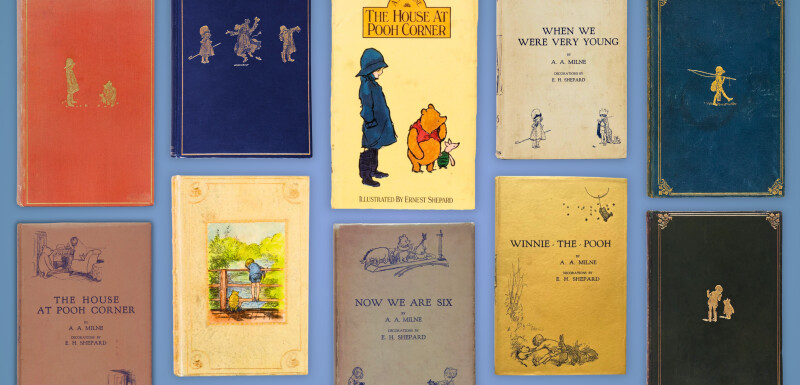
The entire Pooh canon appeared in a concentrated burst of just four years: When We Were Very Young (1924), Winnie-the-Pooh (1926), Now We Are Six (1927), and The House at Pooh Corner (1928).
Today, first editions of Winnie-the-Pooh in dust jacket are among the most collectible children's books ever published, placing them alongside Alice's Adventures in Wonderland and Peter Pan at the top of the children's book market.
Original artwork for Winnie-the-Pooh An original preliminary color drawing by E.H. Shepard (c.1956) for the scene "For some time now Pooh had been saying 'Yes' and 'No' in turn, with his eyes shut, to all that Owl was saying." It was a preparatory drawing for The World of Pooh (1957 omnibus edition) — a redrawn version of the illustration from page 49 of the original 1926 Winnie-the-Pooh. Ink and colored pencil, 113 x 127 mm.
Whether you're a dedicated collector or looking for a meaningful gift, there's something here for every book lover. From first editions to signed copies, here are a few tips to help you build your Winnie-the-Pooh collection.
The hierarchy. The most valuable Pooh items are original Shepard artworks, followed by signed limited editions, first editions with dust jackets, first editions without jackets, and early reprints. Across all categories, condition drives price.
The identifying points. A true first edition of Winnie-the-Pooh carries "First published in 1926" on the copyright page, with no later reprint statements. The first-issue dust jacket is priced "7/6 Net" on the spine and reads "117th Thousand" at the top of the rear flap. The trade first edition had a print run of 35,000 copies, far above the standard 5,000 of the era, but surviving copies with intact dust jackets are scarce.
The limited editions. The UK edition included 350 large-paper copies, printed on handmade paper and signed by both Milne and Shepard. These have distinctive two-tone blue boards. A US limited edition of 200 numbered copies (plus 26 lettered) was also produced, signed by both author and illustrator. All are exceedingly scarce.
The complete set. Collectors seeking a full Pooh quartet in first edition with dust jackets can expect a hefty price tag for a set in presentable condition. First printings did grow with each title: 35,000 for Winnie-the-Pooh, 50,000 for Now We Are Six, and 75,000 for The House at Pooh Corner, reflecting the series rapid rise in popularity.
The centenary effect. Anniversaries drive attention, and attention drives prices. The original 1926 text and illustrations entered the US public domain on January 1, 2022 (95 years after publication, under US copyright law). UK copyright of Milne's text expires on January 1, 2027 (70 years after his death in 1956), while Shepard's illustrations remain protected until January 1, 2047 (70 years after his death in 1976). For collectors, this means new editions and adaptations will continue to appear, but nothing replaces an original.
The book that started it all. Milne's first collection of Pooh stories, featuring Shepard's iconic illustrations, remains the cornerstone of any Pooh collection.
The sequel to Winnie-the-Pooh, introducing Tigger and containing the beloved closing chapter, "In which Christopher Robin and Pooh come to an enchanted place, and we come to the end of the book."
Milne's first poetry collection and the book that introduced the world to Christopher Robin. Includes the poem "Teddy Bear," where Pooh makes his earliest appearance in print.
Complete sets of Milne's four Pooh books, from vintage editions to modern omnibus volumes. A collected set brings together the full world of the Hundred Acre Wood.
A true first edition of Winnie-the-Pooh is identified by the 1926 date on the title page. Copies retaining the original dust jacket are exceptionally scarce.
Copies signed by A.A. Milne, E.H. Shepard, or both are among the rarest and most valuable items in the Pooh collecting world. Shepard continued signing books well into the 1970s.
New collectible editions published for the 2026 centenary, including facsimile reproductions, gold-foiled slipcases, and fully restored color illustrations.
5 most expensive Winnie-the-Pooh items sold on AbeBooks
1. Winnie-the-Pooh — $12,500 One of 350 signed limited large-paper copies (#262), printed on handmade paper and signed by both Milne and Shepard. Blue boards with the original dust jacket. A scarce variant of the 1926 first edition. Sold by The Chatham Bookseller
2. Winnie-the-Pooh — $11,852 A 1926 first edition in near fine condition with the correct first-issue dust jacket, signed by A.A. Milne on a bookplate and warmly inscribed by E.H. Shepard on the title page. Sold by West Hull Rare Books
3. Winnie-the-Pooh (Deluxe Edition) — $10,022 The 1926 UK first deluxe edition in red leather, one of 1,000 copies in this binding. Signed by Shepard on the title page and accompanied by a handwritten letter from Milne dated April 1920, written while his wife was expecting Christopher Robin. Sold by First and Fine
4. The Complete Pooh Quartet — $8,500 A full set of all four first UK editions (When We Were Very Young, Winnie-the-Pooh, Now We Are Six, The House at Pooh Corner) in original first-issue dust jackets, housed in a slipcase. Sold by Bookbid
5. Winnie-the-Pooh, Now We Are Six & The House at Pooh Corner — $7,877 Three UK first editions accompanied by an original handwritten letter from Milne to his lifelong friend Vincent Seligman, lamenting the critical reception of his 1929 play The Ivory Door. Sold by First and Fine