Thursday, 5 December 2013

Pretty Polly: A Novel Panorama Picture Book by E. NesbitPretty Polly
by Edric Vredenburg
Paper engineering is the cutting, gluing and folding of paper to create books and ephemera with pop-ups, pull-tabs, flaps and a variety of other moving parts.  Pop-up and moving books are most commonly associated with children, but some of the earliest movables were academic titles that used the technique to explain anatomy and astronomy.
It wasn’t until the Victorian era that publishing pop-up books became more affordable and they were marketed toward children.  Much of their popularity can be attributed to Ernest Nister or Louis Giraud.  Nister worked in both Germany and England in the 1890s and his publications became well known for the high artistic quality of the pop-ups and illustrations.  Nister introduced many techniques including three-dimensional scenes that lifted into view with the pull of a tab – he also held a patent for the revolving picture mechanism that first appeared in Twinkling Pictures in 1899.
By the 1920s, Giraud burst onto the pop-up scene in Britain.  He had been working in the Daily Express book department where he produced its Children’s Annual, which contained popular cartoons as well as nursery stories and, of course, moving pictures.  Seeing the success of books with spring up models, he formed his own publishing house that would produce the highly successful Bookano series (a combination of Book and Meccano).  Bookano combined popular children’s stories and nursery rhymes with the same pop-up illustrations from the Daily Express annuals.  Like Nister, Giraud’s greatest success came with movable books, but his crowning achievement was producing the Bookano series at affordable prices that would appeal to a mass audience – he pretty much defined the modern children’s pop-up book. We recommend browsing the pop-ups offered by Columbia Books of Missouri for a fascinating selection of moveable books.

Collectible Pop-Up Books

Pop-Up Mickey

Encyclopedia Prehistorica Series

Modern Beasts

Pop-ups for Grown Ups

Pop-up Editions of Classics

The Jungle Book by Matthew Reinhart
The Jungle Book
by Matthew Reinhart
Alice in Wonderland by Voitech Kubasta
Alice in Wonderland
Voitech Kubasta


Wednesday, 4 December 2013

"Until one has loved an animal, a part of one's soul remains 


unawakened" Anatola France


The Autumn people.


 "For these beings, fall is ever the normal season,
the only weather, there be no choice beyond.
Where do they come from? The dust.
Where do they go? The grave.
Does blood stir in their veins? No; he night wind.
What ticks in their head? The worm.
What speaks from their mouth? The toad.
What sees from their eye? The snake.
What hears with their ear? The abyss between the stars.
They sift the human storm for souls, eat the flesh of reason,
fill tombs with sinners. They frenzy forth....
Such are the autumn people. Beware of them.
                                        -Something Wicked This Way Comes - Ray Bradbury.


Organized Bookcase?


Sunday, 1 December 2013

21 “Non-Spiritual” Things that make us Happy.

Via on Nov 21, 2012

21 Simple “Non-Spiritual” Things that make for Daily Happiness.

It’s the Little Things.

What’s something “non-spiritual” or “non-religious” you do that others can do, too, to be happy day-to-day? Say in comments, below. Be specific-ish!
1. Touch water. Whether in the form of a hot bath, a cool drink of water (stay hydrated!), swimming or the ocean, water heals.
2. Sweat once a day. Exercise—find something you enjoy doing, and do it. I like bicycling, climbing, and yoga.
3. Eat real food. If it has more than three ingredients, generally, if you’ve seen an ad for it, generally—skip it.
4. Support, subscribe, read a good magazine (print or online) that’s better than you are—with a hot drink of coffee or tea and a little sunshine and quiet.
5. Keep our clothes off the floor. While a messy house, full of love, can be delightful, our environments reinforce our mental states, just as our physical posture can enlighten or depress us. So let’s practice keeping things relatively clean not out of a sense of uptightness, but out of a sense of matter-of-fact delight in daily beauty, respect and simplicity.
6. Community. Even if we don’t meditate, seeing community—bicycling around, at the dog park, at the grocery, at the cafe—will uplift and open our troubled hearts.
7. Don’t be afraid to be a fool. Smile at a stranger. Smile, period. It gets easier with practice (I say this as someone who doesn’t suffer new agey fools, gladly). Laughter, too, is one thing that’s no less delightful even if you’re faking it until you really mean it.
8. Work in an office, or live with, a dog. Dogs are shown to dramatically up folks’ happiness, and productivity, both. And they’ll force you to get outside. Caveat: only adopt if we’re ready, more or less. Never buy.
9. Breathe in and out, slowly, once a day. Feel one’s breath like the rising, falling waves. Breathe deeply, clearly out old air. Breathe up into one’s collar bones.
@waylonlewis on Instagram
10. Never eat while standing up, or driving. We’ll overeat, generally, and we won’t enjoy the food so much.
12. Hike. Or, just walk. Get out in nature. Or, a park. Nature opens us up, and calms our kleshas.
13. Stop obsessing about one’s own happiness. Help others. In small or ongoing ways.
@waylonlewis: Instagram. elephant tote bag, side one. Organic, Made in USA.
15. Pick up trash in the street. Take a bottle out of the trash, and put it in recycling. Save unused napkins from a restaurant for use at home. Do little things for society that may go “unrewarded.”
16. Watch a movie and eat a little too much ice cream/pop corn/vegan ice cream/edamame/nuts. Collapsing into one’s core once in awhile is necessary to one’s creative energies.
17. Put a few photos of loved ones around.
18. Be honest. This includes doing work for money that we can believe in, or finding a way to feel good about it.
19. Sleep more. Even a little more. I have no idea how, but it’s a good idea.
20. Write. Whether a journal or a blog, expressing oneself is cathartic and sensical-making.


2

Barking Blondes: The health of the Hound Pound

Joanne Good and Anna Webb
barking 224x300 Barking Blondes: The health of the Hound PoundTwo sad bits of news for dog owners in London this week. After 79 years of trading, Harrods have decided to close their famous Pet Kingdom.
A spokesperson for the store told us “Harrods confirms its Pet Kingdom department, located on the Fourth Floor, will close to make way for further exciting planned developments in our womenswear.”
Britain is a nation of animal lovers so this news has shocked suppliers and pet owners alike.The store had a tradition of housing or sourcing four legged friends. It once also sold monkeys, exotics and lions.
Who can forget the very famous story of Christian the lion? Bought from the store in the Seventies by two men living off The Kings Road, Christian soon out grew his environment and was released back into the wild. Never forgetting his original owners this story resulted in literally millions of hits on YouTube.
Despite the recession people are still spending on their pets. The pet industry is up 7.5 per cent year on year. Also pet ownership is growing with dogs and cats neck-and-neck at about 10 million each, filling 54 per cent of households in the UK.
Only three years ago Pet Kingdom was launched taking over the entire top floor. As the largest department of its kind in Europe and the most exclusive, it also contained a pet spa offering pet pampering in a different league offering doga, massage, pawdicures and a wash and blow dry. Pet Kingdom offered deluxe pet accessories, a doggy deli, a fancy dress room, a wall of fame.
In the 1930s Harrods used its basement to house the first ever pet crèche long before New York City took over the trend for doggy day care. Over the years the pet department expanded as the demand for pet accessories grew. The sale of puppies and kittens caused puppy farming campaigners to target Harrods as setting a bad example in an age when selling dogs and cats in pet shops is considered to be supporting the ‘puppy farm’ trade.
So many, may be relieved to see the department close. For us, though, the saddest piece of news this week was to discover Regents Park’s Honest Sausage has closed. This little gem of a café right in the heart of the royal park was a popular haunt for all local dog owners.
We wrote about it in our book Barking Blondes as it was the meeting place we would bump into dog lover Julian Clary. It was where you could buy yesterday’s left over sausages at a reduced price for your dogs. Known as a “dog plate” our two dogs would race towards the chalet café at the end of a long walk, knowing their exertions would be rewarded.
Well now it’s boarded up in preparation for, a no doubt, more lucrative catering franchise. All of us locals are cynically waiting for the “No DOGS ALLOWED” sign to spring up. Thereby ending what was once a lovely, local, spontaneous, dog friendly meeting place.
The sign though remains…”Honest Sausage…honest spirit.”
Bit of a porkie… that
‘Barking Blondes’ by Anna Webb & Jo Good, published by Hamlyn, £12.99


Writers and Food: a Love Story

Writers food
The relationship between writers and food is as old as when the dinosaurs stopped roaming the Earth. Whether they cooked it, consumed it or became so fascinated by it that they almost left it to rot (ahem, Friedrich Schiller?) food has always been important to writers. The importance stems from food being a source of inspiration.
Apples have always inspired writers one way or another. Charles Dickens had an obsession with baked apples. Agatha Christie munched on apples in the bathtub while plotting murders. F. Scott Fitzgerald had once went on an apple-mostly diet while staying at a cheap North Carolina hotel to write essays for Esquire in 1936. The famous Schiller rotting apples story informed us that apples, ripe or malodorous inspired writers to create some of their masterpieces. Jack Kerouac’s favorite dessert was apple pie à la mode, even used it as his character, Sal’s favorite dish in his legendary novel On the Road.
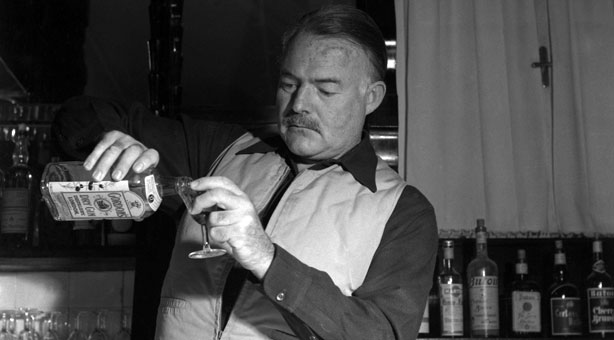
When it came to liquor, there was no greater story than Ernest Hemingway’s. The great American writer not only drank prodigiously, but he also gave whiskey, absinthe, martini, daiquiri and gin & tonic a life of their own in his prose. He not only drank and wrote about it, he also invented cocktails and concoctions. Among his famous “alcohol shipping” quotes is:
“Always do sober what you said you’d do drunk. That will teach you to keep your mouth shut.”
Stephen King even agreed to the stereotype of the “rarely sober writer.” Oscar Wilde had a fascination with champagne. Wilde’s drinking went as far as asking that his favorite bottle -an 1874 Perrier-Jouët- be sent to his cell while imprisoned in 1895. Even in the Muslim world, the controversial, half-Arab, half Persian poet Abu Nawas (756–814) wrote some of his greatest poems in praise of wine. The poems were called khamriyyat or the wine poems. Despite the poet facing a mysterious death in prison due to his notorious lifestyle and homosexuality, his poems were considered the greatest among classical Arabic literature.
Moving on to chocolate, no living person has been known to resist this heavenly food so why would writers? Jane Austen had chocolate for breakfast. Joanne Harris dazzled the world with her novel Chocolat, the first book in the trilogy of the same name, inspired by her own love for confectionery and a family history of kitchen gardening and cookery.
Strangely, not all writers were fond of coffee. Unlike millions of Facebook status updates and viral images that depict coffee as the ultimate source of inspiration, some writers had very unlucky encounters with coffee. Gertrude Stein had always felt wary of caffeine as it elevated her anxiety. Even with a doctor’s prescription ordering her a “cup of coffee a day,” Stein still refused to come near the roasted beans. On the other hand, Marcel Proust had once drank 16 consecutive cups of espresso! Now that’s a story for all the Facebook coffee-nerds.
Were most writers hooked on junk food and unhealthy meals? Not really. Alice Walker, Ralph Waldo Emerson, Isaac Bashevis Singer, Agostinho da Silvo, and Jonathan Safran Foer were vegetarians. J.M. Coetzee exercises regularly and stays away from caffeine, alcohol, tobacco and meat. Lord Byron was a chronic dieter later in his life refusing fish, mutton, and wine when invited to dinner at the home of his friend, poet Samuel Rogers.
According to recent studies, eating proper, healthy food that is good for your brain also makes you a better writer. Foods rich in antioxidants like berries, legumes, artichokes, cranberries, potatoes, apples, plums and pecans have anti-aging properties and protect your brain cells from dementia. Fish oil and sardines, rich in omega-3 fatty acids, boost your brain’s gray matter. Moderate amounts of caffeine through daily intake of coffee and tea, help boost concentration while Folic acid supplements increase the writer’s cognitive functions especially memory and critical thinking.
Writing and food will always develop a love affair of sorts whether dangerous, abusive or platonic. Whenever a writer’s palate is treated to a tasteful experience, a book is most likely to be created.
By: Jaylan Salah