Wednesday, 2 January 2013

intsugi Breasts: Broken is Better than New. ~ Nancy Miller


Sheila reflection
photo credit: Sheila Dunn Art

My body has changed forever.

A week after surgery, a friend of mine gave me a get-well-soon gift: a couple of tubes of lacquer resin, a pair of rubber gloves and a pot full of gold dust with instructions on the art of kintsugi—which is the Japanese craft of fixing broken pottery using  golden joinery.
The gift symbolized a craft for healing my broken body. Instead of a chip in a china teacup, it was my breast that needed mending. Instead of a fracture across an earthenware bowl, it was my spirit that could have used a sprinkling of gold dust.
Last week, when washing up in a new apartment, a glass teapot hit against the metallic sink. The spout cracked off the pot and swam jagged in the dishwater next to my bleeding hand.
“Damn,” I thought, “What a fool I am.  I should have been more careful. I might be able put this back together, but it’s never going to be the same.”
Then I remembered my kintsugi repair set. A sense of determination replaced my frustration.
The kintsugi set hid in a box full of paints, twine and Japanese paper. Finding it, I unfolded the instructions with the spirit of a surgeon, slapped on the pair of rubber gloves and was ready to mend.
I’d forgotten the kind of pleasure that comes with repairing what’s been broken. Embracing attention, precision and patience is a healing art for the spirit—as much as it is for the pottery.
“I’ve been meaning to use that kintsugi set since May,” remembering how I’d been scrounging markets for the right china teacup to hit cathartically with a hammer and put artfully back together again. “Here’s the perfect opportunity.”
“I love working with my hands.” I thought.
Kintsugi tea poA kind of gratification emerges from sewing, molding and drawing that no conceptual practice ever reaches. Crafting returns me back to my corporeality, always present.
When I delicately squeezed out the resin, mixed it methodically with a hint of dust and eyed the faux gold glitter in the kitchen lights, I remembered how gratifying it feels to use my hands in a practical way.
A few hours later, the teapot looked better than new. No longer did it sit like an object indistinguishable amongst others like it on a shelf. No longer did it appear unreachable in its uniform perfection.
Touched with gold dust, mended by hand and loved in patience, the teapot transformed into the embodiment of wabi sabi —wabi sabi being the name for a Japanese aesthetic centred on the acceptance of transience. “Imperfect, impermanent and incomplete” might describe the repaired pot, or it might describe my transient body: on the mend from surgery, waiting to have gold dust sprinkled upon it.
In Anthem, Leonard Cohen sings: “Ring the bells that you still can ring / Forget your perfect offering.”
When I look at my the scars across my breast, I want to forget my “perfect offering.”
When the chorus of our culture is one that seeks to repeat perfect permanence, it’s easy to forget how life and death always sing out their imperfect transience.  So much of advertising feeds off of my sense of lack. When I look at airbrushed breasts in a magazine, at times, it triggers a sense of lack. When I see pictures of couples on billboards in a fleshy embrace, sometimes it elicits a sense of something missing.

My body has changed forever.

Sex may never be the same.
Last week, when I saw a student’s choreography emphasizing the sensuality of the human body with video close-ups of dancer’s breasts, I felt a sense of deficiency triggered by the images. A mastectomy has numbed the sensation across my left breast and throughout the upper arm.
It takes only a pause to think how neither the perfect breasts nor perfect pleasure with a partner has the power to lead me to my self-fulfillment—no relationship built either could ever lead to anything. Those images evoked the pain of loss and fear of rejection. It takes only few breaths to remember that the deepest sensuality is that felt in the heart and not on the surface of the skin. The cracks have opened on the surface of my body.

“There’s a crack in everything,” Cohen sings, “That’s how the light gets in.”

Looking at my cracked body, I envision a bit of repairing in the style of kintsugi— a bit of space opening for the light to get in and a bit of gold dust around the scars. Since receiving news that I am living with an inherited genetic alteration that increases significantly my chances of breast and ovarian cancer, I have been grappling with the decision of what surgery to undergo.
Should I go for mastopexy on the good breast to lift it in symmetry with the removed one? A bilateral risk-reducing mastectomy to remove the tissue of the other breast and replace both with implants or fat from my buttocks? I know what you might be thinking, “Some women set up payment plans for such procedures,” or, “When you’re 90, you’ll have the breasts of a 20-year-old.”
“Life is impermanent,” the verses of life and death call out to me.
“Broken is better than new,” the kintsugi teapot whistles in my ear.
“Pictures of perfection,” writes Jane Austen in letter to Fanny Knight, “make me sick and wicked.”
When I think of the people I have loved, I have trouble remembering having loved anyone for either their body or for their perfection.
Looking at photos of someone I’ve held close, I see how his physical quirks inspired deeper feelings. The lack of wishing for alteration allowed me to embrace his vulnerability. It was easier to see the gold within when I focused less on his appearance: an ability to forgive when there had been rupture, a steadfast integrity to open to the suffering of others and a tendency over time to mend the cracks in love rather than shop for the seemingly seamless.
Some think the secret behind a Stradivarius, that famous million-dollar violin, lies in its imperfections. There are many asymmetries found in that most refined musical instrument—imperfections perhaps intended to remove the unpleasant harmonies found in symmetrical ones.
I look at my asymmetrical body, with all its quirks, modifications, restorations and wonder if a sonata will play from my imperfect instrument. Looking at the mending happening now on the surface of skin, I remember the heart beneath it, a center aspiring to open to what’s been torn, a center with its own song. It strikes out beneath the cracked and gold-dusted form beyond and because of brokenness.

Nancy MillerNancy is a writer, artist, yogini and teacher living in London, England.  She has taught and trained in yoga and meditation in Thailand, India, Nepal, Mexico and Canada. On March 16th, 2012, Nancy was diagnosed with invasive ductal carcinoma, or breast cancer. Through living with this disease, Nancy has been learning to trust the way her spirit dances though all things and reform what to her is yoga. (www.paperbirchyoga.com)


The Daily Routines of Famous Writers

by
“A writer who waits for ideal conditions under which to work will die without putting a word on paper.”
Kurt Vonnegut’s recently published daily routine made we wonder how other beloved writers organized their days. So I pored through various old diaries and interviews — many from the fantastic Paris Review archives — and culled a handful of writing routines from some of my favorite authors. Enjoy.

Ray Bradbury, a lifelong proponent of working with joy and an avid champion of public libraries, playfully defies the question of routines in this 2010 interview:
My passions drive me to the typewriter every day of my life, and they have driven me there since I was twelve. So I never have to worry about schedules. Some new thing is always exploding in me, and it schedules me, I don’t schedule it. It says: Get to the typewriter right now and finish this.
[…]
I can work anywhere. I wrote in bedrooms and living rooms when I was growing up with my parents and my brother in a small house in Los Angeles. I worked on my typewriter in the living room, with the radio and my mother and dad and brother all talking at the same time. Later on, when I wanted to write Fahrenheit 451, I went up to UCLA and found a basement typing room where, if you inserted ten cents into the typewriter, you could buy thirty minutes of typing time.

Joan Didion creates for herself a kind of incubation period for ideas, articulated in this 1968 interview:
I need an hour alone before dinner, with a drink, to go over what I’ve done that day. I can’t do it late in the afternoon because I’m too close to it. Also, the drink helps. It removes me from the pages. So I spend this hour taking things out and putting other things in. Then I start the next day by redoing all of what I did the day before, following these evening notes. When I’m really working I don’t like to go out or have anybody to dinner, because then I lose the hour. If I don’t have the hour, and start the next day with just some bad pages and nowhere to go, I’m in low spirits. Another thing I need to do, when I’m near the end of the book, is sleep in the same room with it. That’s one reason I go home to Sacramento to finish things. Somehow the book doesn’t leave you when you’re asleep right next to it. In Sacramento nobody cares if I appear or not. I can just get up and start typing.

E. B. White, in the same fantastic interview that gave us his timeless insight on the role and responsibility of the writer, notes his relationship with sound and ends on a note echoing Tchaikovsky on work ethic:
I never listen to music when I’m working. I haven’t that kind of attentiveness, and I wouldn’t like it at all. On the other hand, I’m able to work fairly well among ordinary distractions. My house has a living room that is at the core of everything that goes on: it is a passageway to the cellar, to the kitchen, to the closet where the phone lives. There’s a lot of traffic. But it’s a bright, cheerful room, and I often use it as a room to write in, despite the carnival that is going on all around me. A girl pushing a carpet sweeper under my typewriter table has never annoyed me particularly, nor has it taken my mind off my work, unless the girl was unusually pretty or unusually clumsy. My wife, thank God, has never been protective of me, as, I am told, the wives of some writers are. In consequence, the members of my household never pay the slightest attention to my being a writing man — they make all the noise and fuss they want to. If I get sick of it, I have places I can go. A writer who waits for ideal conditions under which to work will die without putting a word on paper.

Photograph by Tom Palumbo, 1956
Jack Kerouac describes his rituals and superstitions in 1968:
I had a ritual once of lighting a candle and writing by its light and blowing it out when I was done for the night … also kneeling and praying before starting (I got that from a French movie about George Frideric Handel) … but now I simply hate to write. My superstition? I’m beginning to suspect the full moon. Also I’m hung up on the number nine though I’m told a Piscean like myself should stick to number seven; but I try to do nine touchdowns a day, that is, I stand on my head in the bathroom, on a slipper, and touch the floor nine times with my toe tips, while balanced. This is incidentally more than yoga, it’s an athletic feat, I mean imagine calling me ‘unbalanced’ after that. Frankly I do feel that my mind is going. So another ‘ritual’ as you call it, is to pray to Jesus to preserve my sanity and my energy so I can help my family: that being my paralyzed mother, and my wife, and the ever-present kitties. Okay?
He then adds a few thought on the best time and place for writing:
The desk in the room, near the bed, with a good light, midnight till dawn, a drink when you get tired, preferably at home, but if you have no home, make a home out of your hotel room or motel room or pad: peace.

Susan Sontag resolves in her diary in 1977, adding to her collected wisdom on writing:
Starting tomorrow — if not today:
I will get up every morning no later than eight. (Can break this rule once a week.)
I will have lunch only with Roger [Straus]. (‘No, I don’t go out for lunch.’ Can break this rule once every two weeks.)
I will write in the Notebook every day. (Model: Lichtenberg’s Waste Books.)
I will tell people not to call in the morning, or not answer the phone.
I will try to confine my reading to the evening. (I read too much — as an escape from writing.)
I will answer letters once a week. (Friday? — I have to go to the hospital anyway.)
Then, in a Paris Review interview nearly two decades later, she details her routine:
I write with a felt-tip pen, or sometimes a pencil, on yellow or white legal pads, that fetish of American writers. I like the slowness of writing by hand. Then I type it up and scrawl all over that. And keep on retyping it, each time making corrections both by hand and directly on the typewriter, until I don’t see how to make it any better. Up to five years ago, that was it. Since then there is a computer in my life. After the second or third draft it goes into the computer, so I don’t retype the whole manuscript anymore, but continue to revise by hand on a succession of hard-copy drafts from the computer.
[…]
I write in spurts. I write when I have to because the pressure builds up and I feel enough confidence that something has matured in my head and I can write it down. But once something is really under way, I don’t want to do anything else. I don’t go out, much of the time I forget to eat, I sleep very little. It’s a very undisciplined way of working and makes me not very prolific. But I’m too interested in many other things.

In 1932, under a section titled Daily Routine, Henry Miller footnotes his 11 commandments of writing with this wonderful blueprint for productivity, inspiration, and mental health:
MORNINGS:
If groggy, type notes and allocate, as stimulus.
If in fine fettle, write.
AFTERNOONS:
Work of section in hand, following plan of section scrupulously. No intrusions, no diversions. Write to finish one section at a time, for good and all.
EVENINGS:
See friends. Read in cafés.
Explore unfamiliar sections — on foot if wet, on bicycle if dry.
Write, if in mood, but only on Minor program.
Paint if empty or tired.
Make Notes. Make Charts, Plans. Make corrections of MS.
Note: Allow sufficient time during daylight to make an occasional visit to museums or an occasional sketch or an occasional bike ride. Sketch in cafés and trains and streets. Cut the movies! Library for references once a week.

In this 1965 interview, Simone de Beauvoir contributes to dispelling the “tortured-genius” myth of writing:
I’m always in a hurry to get going, though in general I dislike starting the day. I first have tea and then, at about ten o’clock, I get under way and work until one. Then I see my friends and after that, at five o’clock, I go back to work and continue until nine. I have no difficulty in picking up the thread in the afternoon. When you leave, I’ll read the paper or perhaps go shopping. Most often it’s a pleasure to work.
[…]
If the work is going well, I spend a quarter or half an hour reading what I wrote the day before, and I make a few corrections. Then I continue from there. In order to pick up the thread I have to read what I’ve done.

Ernest Hemingway, who famously wrote standing (“Hemingway stands when he writes. He stands in a pair of his oversized loafers on the worn skin of a lesser kudu—the typewriter and the reading board chest-high opposite him.”), approaches his craft with equal parts poeticism and pragmatism:
When I am working on a book or a story I write every morning as soon after first light as possible. There is no one to disturb you and it is cool or cold and you come to your work and warm as you write. You read what you have written and, as you always stop when you know what is going to happen next, you go on from there. You write until you come to a place where you still have your juice and know what will happen next and you stop and try to live through until the next day when you hit it again. You have started at six in the morning, say, and may go on until noon or be through before that. When you stop you are as empty, and at the same time never empty but filling, as when you have made love to someone you love. Nothing can hurt you, nothing can happen, nothing means anything until the next day when you do it again. It is the wait until the next day that is hard to get through.

Don DeLillo tells The Paris Review in 1993:
I work in the morning at a manual typewriter. I do about four hours and then go running. This helps me shake off one world and enter another. Trees, birds, drizzle — it’s a nice kind of interlude. Then I work again, later afternoon, for two or three hours. Back into book time, which is transparent — you don’t know it’s passing. No snack food or coffee. No cigarettes — I stopped smoking a long time ago. The space is clear, the house is quiet. A writer takes earnest measures to secure his solitude and then finds endless ways to squander it. Looking out the window, reading random entries in the dictionary. To break the spell I look at a photograph of Borges, a great picture sent to me by the Irish writer Colm Tóín. The face of Borges against a dark background — Borges fierce, blind, his nostrils gaping, his skin stretched taut, his mouth amazingly vivid; his mouth looks painted; he’s like a shaman painted for visions, and the whole face has a kind of steely rapture. I’ve read Borges of course, although not nearly all of it, and I don’t know anything about the way he worked — but the photograph shows us a writer who did not waste time at the window or anywhere else. So I’ve tried to make him my guide out of lethargy and drift, into the otherworld of magic, art, and divination.

Productivity maniac Benjamin Franklin had a formidably rigorous daily routine:

Image by Nick Bilton
Haruki Murakami shares the mind-body connection noted by some of history’s famous creators:
When I’m in writing mode for a novel, I get up at 4:00 am and work for five to six hours. In the afternoon, I run for 10km or swim for 1500m (or do both), then I read a bit and listen to some music. I go to bed at 9:00 pm. I keep to this routine every day without variation. The repetition itself becomes the important thing; it’s a form of mesmerism. I mesmerize myself to reach a deeper state of mind.

William Gibson tells the Paris Review in 2011:
When I’m writing a book I get up at seven. I check my e-mail and do Internet ablutions, as we do these days. I have a cup of coffee. Three days a week, I go to Pilates and am back by ten or eleven. Then I sit down and try to write. If absolutely nothing is happening, I’ll give myself permission to mow the lawn. But, generally, just sitting down and really trying is enough to get it started. I break for lunch, come back, and do it some more. And then, usually, a nap. Naps are essential to my process. Not dreams, but that state adjacent to sleep, the mind on waking.
[…]
As I move through the book it becomes more demanding. At the beginning, I have a five-day workweek, and each day is roughly ten to five, with a break for lunch and a nap. At the very end, it’s a seven-day week, and it could be a twelve-hour day.
Toward the end of a book, the state of composition feels like a complex, chemically altered state that will go away if I don’t continue to give it what it needs. What it needs is simply to write all the time. Downtime other than simply sleeping becomes problematic. I’m always glad to see the back of that.

Maya Angelou shares her day with Paris Review in 1990:
I write in the morning and then go home about midday and take a shower, because writing, as you know, is very hard work, so you have to do a double ablution. Then I go out and shop — I’m a serious cook — and pretend to be normal. I play sane — Good morning! Fine, thank you. And you? And I go home. I prepare dinner for myself and if I have houseguests, I do the candles and the pretty music and all that. Then after all the dishes are moved away I read what I wrote that morning. And more often than not if I’ve done nine pages I may be able to save two and a half or three. That’s the cruelest time you know, to really admit that it doesn’t work. And to blue pencil it. When I finish maybe fifty pages and read them — fifty acceptable pages — it’s not too bad. I’ve had the same editor since 1967. Many times he has said to me over the years or asked me, Why would you use a semicolon instead of a colon? And many times over the years I have said to him things like: I will never speak to you again. Forever. Goodbye. That is it. Thank you very much. And I leave. Then I read the piece and I think of his suggestions. I send him a telegram that says, OK, so you’re right. So what? Don’t ever mention this to me again. If you do, I will never speak to you again. About two years ago I was visiting him and his wife in the Hamptons. I was at the end of a dining room table with a sit-down dinner of about fourteen people. Way at the end I said to someone, I sent him telegrams over the years. From the other end of the table he said, And I’ve kept every one! Brute! But the editing, one’s own editing, before the editor sees it, is the most important.

Anaïs Nin simply notes, in a 1941 parenthetical comment, in the third volume of her diaries:
I write my stories in the morning, my diary at night.
She then adds in the fifth volume, in 1948.
I write every day. … I do my best work in the morning.
Lastly, the Kurt Vonnegut routine that inspired this omnibus, recorded in a letter to his wife in 1965:
In an unmoored life like mine, sleep and hunger and work arrange themselves to suit themselves, without consulting me. I’m just as glad they haven’t consulted me about the tiresome details. What they have worked out is this: I awake at 5:30, work until 8:00, eat breakfast at home, work until 10:00, walk a few blocks into town, do errands, go to the nearby municipal swimming pool, which I have all to myself, and swim for half an hour, return home at 11:45, read the mail, eat lunch at noon. In the afternoon I do schoolwork, either teach of prepare. When I get home from school at about 5:30, I numb my twanging intellect with several belts of Scotch and water ($5.00/fifth at the State Liquor store, the only liquor store in town. There are loads of bars, though.), cook supper, read and listen to jazz (lots of good music on the radio here), slip off to sleep at ten. I do pushups and sit-ups all the time, and feel as though I am getting lean and sinewy, but maybe not. Last night, time and my body decided to take me to the movies. I saw The Umbrellas of Cherbourg, which I took very hard. To an unmoored, middle-aged man like myself, it was heart-breaking. That’s all right. I like to have my heart broken.
For more wisdom from beloved authors, complement with Kurt Vonnegut’s 8 rules for a great story, Joy Williams on why writers write, David Ogilvy’s 10 no-bullshit tips, Henry Miller’s 11 commandments, Jack Kerouac’s 30 beliefs and techniques, John Steinbeck’s 6 pointers, and Susan Sontag’s synthesized learnings.

Famous Resolution Lists: Jonathan Swift, Susan Sontag, Marilyn Monroe, Woody Guthrie

by
“Stay glad. Keep hoping machine running. Love everybody. Make up your mind.”
‘Tis the season for New Year’s resolutions, but instead of regurgitating the most common ones — like changing habit loops, exercising more, and being more productive — here is a look at some of history’s more unusual resolution lists from the diaries, letters, and personal effects of cultural icons:
JONATHAN SWIFT
Writing in A Tale of a Tub in 1699, at the age of 32, Jonathan Swift — best-known as the author of Gulliver’s Travels author — compiled a list of 17 aspirations for his far future, titled “When I come to be old.” Focusing on wisdom, humility, patience, and justice, the list brings to mind Benjamin Franklin’s famous thirteen virtues, penned around the same time.

When I come to be old. 1699.
Not to marry a young Woman.
Not to keep young Company unless they reely desire it.
Not to be peevish or morose, or suspicious.
Not to scorn present Ways, or Wits, or Fashions, or Men, or War, &c.
Not to be fond of Children, or let them come near me hardly.
Not to tell the same story over and over to the same People.
Not to be covetous.
Not to neglect decency, or cleenlyness, for fear of falling into Nastyness.
Not to be over severe with young People, but give Allowances for their youthfull follyes and weaknesses.
Not to be influenced by, or give ear to knavish tatling servants, or others.
Not to be too free of advise, nor trouble any but those that desire it.
To desire some good Friends to inform me wch of these Resolutions I break, or neglect, and wherein; and reform accordingly.
Not to talk much, nor of my self.
Not to boast of my former beauty, or strength, or favor with Ladyes, &c.
Not to hearken to Flatteryes, nor conceive I can be beloved by a young woman, et eos qui hereditatem captant, odisse ac vitare.
Not to be positive or opiniative.
Not to sett up for observing all these Rules; for fear I should observe none.
SUSAN SONTAG
In 1972, 39-year-old Susan Sontag noted in her diary:
Kindness, kindness, kindness.
I want to make a New Year’s prayer, not a resolution. I’m praying for courage.
Then, in early 1977, she resolved:
Starting tomorrow — if not today:
I will get up every morning no later than eight. (Can break this rule once a week.)
I will have lunch only with Roger [Straus]. (‘No, I don’t go out for lunch.’ Can break this rule once every two weeks.)
I will write in the Notebook every day. (Model: Lichtenberg’s Waste Books.)
I will tell people not to call in the morning, or not answer the phone.
I will try to confine my reading to the evening. (I read too much — as an escape from writing.)
I will answer letters once a week. (Friday? — I have to go to the hospital anyway.)
MARILYN MONROE
In the winter of 1955, a 29-year-old Marilyn Monroe resolved in her leather-bound address book to do things better. The list comes from Fragments, the fantastic tome that gave us Monroe’s moving unpublished poetry.


Must make effort to do
Must have the dicipline to do the following –
z — go to class — my own always — without fail
x — go as often as possible to observe Strassberg’s other private classes
g — never miss actor’s studio sessions
v — work whenever possible — on class assignments — and always keep working on the acting exercises
u — start attending Clurman lectures — also Lee Strassberg’s directors lectures at theater wing — enquire about both
l — keep looking around me — only much more so — observing — but not only myself but others and everything — take things (it) for what they (it’s) are worth
y — must make strong effort to work on current problems and phobias that out of my past has arisen — making much much much more more more more more effort in my analisis. And be there always on time — no excuses for being ever late.
w — if possible — take at least one class at university — in literature –
o — follow RCA thing through.
p — try to find someone to take dancing from — body work (creative)
t — take care of my instrument — personally & bodily (exercise)

try to enjoy myself when I can — I’ll be miserable enough as it is.
WOODY GUTHRIE
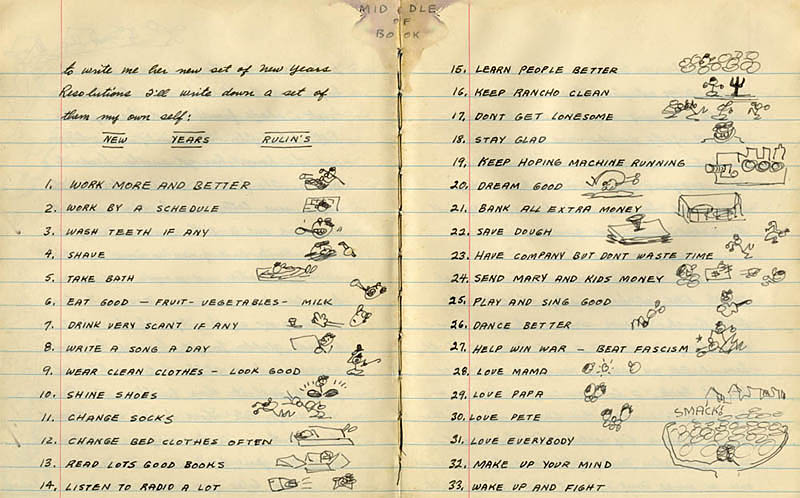
In 1942, 30-year-old Woody Guthrie penned a 33-point compendium of “New Years Rulin’s.” The list, originally featured here in 2011, is equal parts brave and vulnerable, brimming with a kind of heart-warming earnestness we’ve come to be tragically cynical about.

  1. Work more and better
  2. Work by a schedule
  3. Wash teeth if any
  4. Shave
  5. Take bath
  6. Eat good — fruit — vegetables — milk
  7. Drink very scant if any
  8. Write a song a day
  9. Wear clean clothes — look good
  10. Shine shoes
  11. Change socks
  12. Change bed cloths often
  13. Read lots good books
  14. Listen to radio a lot
  15. Learn people better
  16. Keep rancho clean
  17. Dont get lonesome
  18. Stay glad
  19. Keep hoping machine running
  20. Dream good
  21. Bank all extra money
  22. Save dough
  23. Have company but dont waste time
  24. Send Mary and kids money
  25. Play and sing good
  26. Dance better
  27. Help win war — beat fascism
  28. Love mama
  29. Love papa
  30. Love Pete
  31. Love everybody
  32. Make up your mind
  33. Wake up and fight
Now, wash these down with this brief history of the to-do list and the psychology of its success and revisit last year’s resolution to read more and write better.


The top 100 most searched for out-of-print books


Our friends at BookFinder compile one of the most interesting lists in the book business – the top 100 most searched for out-of-print books in the United States. Sadly, books fall out-of-print when publishers decide that there isn’t enough demand. That’s when the used book market becomes important for ensuring that these hard-to-find titles can still be found and bought.
The most recent list is diverse. Madonna’s famous Sex (one of the book’s few images that we could publish is seen left) is top of the list as always and Codex Seraphinianus by Luigi Serafini – dubbed the world’s weirdest book – is also in the top 10. There’s also a cookbook from actor and fine food connoisseur Vincent Price.
There are many famous authors on the list, including Stephen King (twice), Nora Roberts, Ray Bradbury, Barbara Cartland, Carl Sagan, C.S. Lewis and Madeleine L’Engle. There are also books from major artists like Salvador Dali and Cecil Beaton, and the autobiography of musician Johnny Cash.
A small number of these books are so scarce now that even AbeBooks booksellers do not have copies. In some cases, only a handful of copies are now available which means prices have become high.

Top 100 Most Searched for Out-of-Print Books

1. Sex
by Madonna
2. Rage
by Stephen King/Richard Bachman
3. Promise Me Tomorrow
by Nora Roberts
4. My Pretty Pony
by Stephen King
5. Pure, White & Deadly; The Problem of Sugar
by John Yudkin
6. Mandingo
by Kyle Onstott
7. Man in Black
by Johnny Cash
8. Codex Seraphinianus
by Luigi Serafini
9. 365 Bedtime Stories
by Nan Gilbert
10. Tudor Roses
by Alice Starmore
11. Fast Times at Ridgemont High
by Cameron Crowe
12. A Treasury of Great Recipes
by Mary & Vincent Price
13. Dark Carnival
by Ray Bradbury
14. The Jerusalem Bible
illustrated by Salvador Dali
15. Sisters
by Lynne Cheney
16. Arithmetic Progress Papers
by H. Henry Thomas
17. Beyond the Plough
by Janet Woods
18. Labyrinth: A Novel
by A.C.H. Smith
19. In a Dark Place: The Story of a True Haunting
by Ray Garton
20. I Go Pogo
by Walt Kelly
21. Phoebe and the Hot Water Bottles
by Linda Dawson & Terry Furchgott
22. Advise and Consent
by Allen Drury
23. The Centurions
by Jean Larteguy
24. Fly Fishing: Memories of Angling Days
by J.R. Hartley
25. Little Witch
by Anna Elizabeth Bennett
26. Collector’s Guide to Colt .45 Service Pistols
by Charles W. Clawson
27. Reflections of Nero Culture, History & Representation
by Jaś Elsner
28. The Allegory of Love: A Study in Medieval Tradition
by C.S. Lewis
29. The Bishop’s Wife
by Robert Nathan
30. Ilsa
by Madeleine L’Engle
31. The Reluctant King: The Life and Reign of George VI, 1895-1952
by Sarah Bradford
32. Murmurs of Earth
by Carl Sagan
33. Cards As Weapons
by Ricky Jay
34. British Battleships of World War Two
by Alan Raven & John Roberts
35. The Book of Indians
by Clancy Holling
36. Halloween
by Curtis Richards
37. Good Vibes
by Jay Cronley
38. The Golden Book of the Civil War
by Charles Flato
39. Ticket to Ride
by Dennis Potter
40. Hell, I Was There
by Elmer Keith
41. House of Bondage
by Ernest Cole
42. The Pink Dress
by Anne Alexander
43. The Big Country
by Donald Hamilton
44. Stuart: A History of the American Light Tank
by R.P. Hunnicutt
45. Big League Sales Closing Techniques
by Les Dane
46. A Payroll to Meet: A Story of Greed, Corruption, and Football at SMU
by David Whitford
47. Too Good to be Threw
by Kate Holmes
48. A Treasury of American Prints
by Thomas Craven
49. To Drop a Dime
by Paul Hoffman
50. Country Landscapes in Watercolor
by John Blockley
51. Crochet Lace: An illustrated Guide to Making Crochet Lace Fabrics
by Mary Konior
52. The Glass of Fashion
by Cecil Beaton
53. The Act of Creation
by Arthur Koestler
54. Bowman of Crecy
by Ronald Welch
55. The Windflower
by Laura London
56. The King Ranch
by Tom Lea
57. The Assembly Line
by Milt Tenopir
58. Practical Gunsmithing
by Edward Matunas
59. Tellers of Tales: 100 Short Stories from the United States, England, France, Russia and Germany
by W Somerset Maugham
60. The Star Conquerors
by Ben Bova
61. Eve of the End
by Allan D Richter
62. Mastering Atmosphere & Mood in Watercolor
by Joseph Zbukvic
63. Second Sight
by David Williams
64. Covenant with Death
by John Harris
65. The Blood Star
by Nicholas Guild
66. McCoys: Their Story as Told to the Author by Eye Witnesses and Descendants
by Truda Williams McCoy
67. The Magic Talisman
by John Blaine
68. The Vision and Beyond
by David Wilkerson
69. The House Without Windows
by Barbara Newhall Follett
70. Pancakes A to Z
by Marie Simmons
71. She Is The Darkness
by Glen Cook
72. Cyborg
by Martin Caidin
73. Currier & Ives: Printmakers to the American People
by Harry Twyford Peters
74. The Wonderful Fashion Doll
by Laura Bannon
75. Jennie / The Abandoned
by Paul Gallico
76. The Bumper Book: A Harvest of Stories and Verses
by Watty Piper
77. The Modern Gunsmith
by James Virgil Howe
78. Drum
by Kyle Onstott
79. Carriage Entrance
by Polan Banks
80. The Septuagint Bible
by Charles Thomson
81. Basic Building Data: 10,000 Timeless Construction Facts
by Don Graf
82. Notations
by John Cage
83. Birds of Britain
by John D. Green
84. Apple Pigs
by Ruth Orbach
85. The Ideal Communist City
by Alexei Gutnov
86. Coal
by Jason Grant
87. War in the Modern Great Power System 1495-1975
by Jack S. Levy
88. A Treasury of Grand Opera
edited by Henry W. Simon
89. Our Journey in the Life
by Doyle C. Barnes
90. Approaches to Translation
by Peter Newmark
91. The Black Sun
by Kyle Onstott & Lance Horner
92. Turkish Delight
by Jan Wolkers
93. Almonds and Raisins
by Maisie Mosco
94. Alvin Fog, Texas Ranger
by John Thomas Edson
95. Basic Medical Laboratory Subjects
by Hugh Woosley
96. Hand and Rod Puppets
by Hansjurgen Fettig
97. The Lost Boys
by Craig Shaw Gardner
98. 102 Favorite Paintings
by Norman Rockwell
99. The Imperialists
by William Stuart Long
100. Against the Stream
by Barbara Cartland


Tuesday, 1 January 2013

The Post 50 Dinner Party

A Call to the Sacred Masculine: Ten Daring Invitations from the Divine Feminine.


Sounds good to me !


Photo: Michael Julian Berz

If I am going act like a goddess, I want a man who acts like a god.

Yet all this talk lately of the goddess and the Divine Feminine seems like new-age wishful thinking, a fantasy archetype with as much to do with real life as Superwoman or the Fairy God Mother.
While goddess propagandists promote the unilateral concept of a spiritually elevated womanhood—strong but supple, decisive and nurturing, wild yet wise—glaringly absent is a call to the Sacred Masculine counterpoint. Women can forever rally around each other, cheerleading new heights of intuitive and open-hearted power, but without the cooperation of menfolk stealing their own fire from the gods, we are preaching to the sistah choir.
Bottomline? Organizing a spiritual revolution as women without inviting men to the front lines with us means we are orchestrating a collective reframe with only half the available power. Real change means humanity—yes both genders—opts for the cosmic upgrade to Divine Class together.

So, on behalf of the X chromosome, here is my invitation to mortal men who wish to dance as gods with wanna-be goddesses.

1. Show us your heroic heart. We know you want to save what is worth saving and to rescue this planet from peril. Wage a hero’s battle against poverty, needless strife, environmental ruin or whatever stirs your courageous heart. It might be a plan to increase your neighborhood safety, to improve your child’s education, to plant a vegetable garden in your backyard or to stop prejudice wherever you see it. The world needs your brave heart to take bold action.
2. Unsheathe your sword. As a man, you wield a sword of truth that can cut through cultural distractions to what really matters. The faster car, the better sports team, the bigger salary are all fine and dandy but on your deathbed, what unfulfilled vision will you regret the most? What risk did you back away from? What chance did you refuse to take? Before you die, be bold enough to discover and live your truth.
3. Dare to dream. Before you played the role of mortal, you (well, we) created the heavens and earth. What do you wish to create here and now? What beautiful order do you wish to bring forth from the chaos of this world. What implausible dream do you want to manifest for the greater good of all? It doesn’t have to be grand, like solving world hunger. It can be simple, like solving your child’s homework problem because you are dedicated to being a great father. All we care about is that something brings you alive with passion.
4. Steer the ship. Aim your life for a noble horizon. It’s not like there’s a second in command who will captain your destiny while you snooze on the sofa after too many beers and potato chips with the TV droning in the background. Get to the helm of your life and navigate by your own pole star, the true north of your heart’s burning desire. Tip: if you don’t know what port you’re headed for, no wind is favorable.
5. Bring your soul to work. Work for more than the mortgage and car payments—work because you find some measure of joy in your job. And if the job is just to make ends meet for now, then meet that employment with gratitude and a call to service. Know that it’s not what you do, but what you bring to what you do, that matters.
6. Care deeply. As a man, you might have been taught to feel lightly and think hard, to hold your emotions back, as if you can build a dam against what naturally must flow. But your caring is what this world cries for. The tender-hearted masculine is both wise and merciful. When you weep, you give women permission to be strong. When your heart breaks we want to know it so that we can heal it together.
7. Love fearlessly. Show us the way by standing firm when we are in a beautiful rage. Don’t run from our fury—after all it might contain magical wisdom. In the gale force of feminine anger, your calm is a powerful reminder that we are met and accepted by our beloved partner.
8. Ravish your woman. Every now and then, take her wholeheartedly, without apology. Press her against a wall and bind her with your kisses. Possess your goddess, oh great god that you are, and then let her possess you. Polarity is a potent nectar and the current runs both ways.
9. Slay your demons. We all have them, the dark part of our hearts, the crevices where our fear and loathing hideout. Notice what keeps you awake at night and stalk it. Hunt your darkness and drag it into the light for loving and healing.
10. Leave your mark. Don’t settle for a fleeting cameo in which your appearance in this kingdom is so quickly forgotten. What do you want your children to say about you? Your great-grandchildren? The greatest legacy is not the wealth you leave behind, but your heartfelt message that echoes forward to future generations.
Ultimately, this dance of the divine in both genders is not about lighting incense, chanting at kirtan, wearing white or even gathering in gender-specific goddess groups or men’s Iron John style movements designed to reclaim a lost chest-thumping masculine. Rather, it’s about being real 360-degree humans, embracing both the sacred and the mundane within ourselves and each other.
When men are willing to meet women heart-first and to live from that divine place of kingly wisdom, warrior courage and boy-like vulnerability, we women are given the gift of receiving all of you. And we are given permission to reveal all of who we are—the nurturing goddess, the juicy seductress and yes, even the nasty b*tch.
In the end, the call to a Divine Feminine and Sacred Masculine is perhaps just the simple yearning to get out of our crazy-busy heads and into our still-knowing hearts. As Rumi says, “I looked in Temples, Churches and Mosques. I found the Divine in my heart.”
Whatever the divine really is, let’s find it together.

“In many shamanic societies, if you came to a medicine person complaining of being disheartened, dispirited, or depressed, they would ask one of four questions…”


The four universal healing salves.

In many shamanic societies, if you came to a shaman or medicine person complaining of being disheartened, dispirited, or depressed, they would ask one of four questions.
When did you stop dancing?
When did you stop singing?
When did you stop being enchanted by stories?
When did you stop finding comfort in the sweet territory of silence?
Where we have stopped dancing, singing, being enchanted by stories, or finding comfort in silence is where we have experience the loss of soul.
Dancing, singing, storytelling, and silence are the four universal healing salves.
~ The Four-Fold Way: Walking the Paths of the Warrior, Healer, Teacher and Visionary