Wednesday, 7 June 2017

The Surprising Science behind Essential Oils & Digestive Health. Via Jodi Sternoff Cohen

get elephant's newsletter
*Editor’s note: Elephant is not your doctor or hospital. Our lawyers would say “this website is not designed to, and should not be construed to provide medical advice, professional diagnosis, opinion or treatment to you or any other individual, and is not intended as a substitute for medical or professional care and treatment. Always consult a health professional before trying out new home therapies or changing your diet.” But we can’t afford lawyers, and you knew all that.
Our health depends not just on what we eat, but on the optimal function of the digestive system to digest, absorb, and assimilate nutrients and efficiently eliminate waste products.
This optimal digestive cascade can only occur in the relaxed “rest and digest” parasympathetic state of the nervous system. When the body is in stress, it drops into the sympathetic fight-or-flight state to flee from danger and shuts down all functions that are not necessary to survival, including the digestive system.
In ideal circumstances, our digestive system is the primary channel for carrying healing nutrients and energy into the body. Unfortunately for many of us, the cumulative damage of processed foods, GMOs, chemically-treated water, environmental toxins, increased stress, and not eating in the parasympathetic state have impeded the optimal function of our digestive systems.
When our digestion is compromised, it’s challenging to assimilate nutrients through the digestive tract. This is one of the reasons that many people continually test low for nutrients like Vitamin D, Vitamin B, Zinc, or Iron, despite frequent supplementation.
But the good news is that even if the front door to healing—the digestive system—is partially blocked or closed, the body does have some back doors to access the system. These backdoors are the sense of smell, known as the olfactory system, and the skin.
Essential oils are uniquely suited to open these backdoors, bypassing a compromised digestive system to offer the healing we’ve been looking for.

Essential oils stimulate the parasympathetic “rest-and-digest” state.

Digestion actually begins with the brain. The smell of food triggers the brain to send signals to the gastrointestinal tract, triggering the parasympathetic digestive cascade. This parasympathetic response is activated by the vagus nerve, one of two extremely long cranial nerves that extend from the brain through every organ of digestion in the abdomen.
It is the vagus nerve that triggers all the parasympathetic responses, including the digestive cascade, which includes:
>> The mouth releasing saliva to help break down carbohydrates.
>> The stomach releasing stomach acid to help digest proteins more completely.
>> The pancreas releasing digestive enzymes.
>> The gallbladder releasing bile to support fat digestion and detoxification of old hormones.
>> The small intestine absorbing and assimilating nutrients. The parasympathetic state triggers peristalsis, the muscle contractions that move food and waste through the digestive tract. A lack of motility can lead to microbial imbalances, like IBS, SIBO and candida.
>> Large intestine relaxing the sphincters for optimal elimination of waste. Inducing the parasympathetic state is a great solution for constipation issues. When we are in stress (sympathetic fight-or-flight state) or just being busy, the heart rate increases, blood pressure increases, respiration quickens, and blood flow is routed toward external muscles to help with flight in the case of an emergency. The blood flows away from internal organs of digestion, which essentially shuts down the digestive process.

Essential oils trigger the parasympathetic response.

There are several ways to trigger the parasympathetic state during meals, including mindful breathing, sitting in an upright position at the table, and consciously eating in a slow, relaxed way. Unfortunately for many of us, the stresses of life—physiological, emotional, work, family, relationships, environmental—make it challenging to fully relax.
Essential plant oils are uniquely suited to help people relax before meals for many reasons. We know that the brain needs nutrients, circulation, and stimulation. The latter element, stimulation, is the hardest to provide through diet alone. This is where essential oils, with their unique abilities to reach the inner-brain through nasal pathways and stimulate the nerve endings in the skin (which connect to the parasympathetic nervous system) fill a critical void.

How to use essential oils to trigger the parasympathetic state for optimal digestion.

Your skin, your largest organ, is relatively permeable to fat-soluble substances like essential oils. The molecules of essential oils are so small that they can pass through your skin into the capillaries and quickly be absorbed into the bloodstream. One study found that the constituents of topically-applied lavender oil were measurable in the blood within 20 minutes, and stayed in the blood system for up to 90 minutes.
This transdermal channel is the reason nicotine patches, motion-sickness patches, and hormone creams work. The transdermal channel also bypasses the stomach and liver, both of which chemically alter the therapeutic effects of drugs and essential oils.
To receive this benefit for digestion, apply essential oils behind the earlobe on the mastoid bone, where it is most accessible to the surface of the skin.
Essential oils can be miraculous for healing by themselves, but when combined into blends they often emphasize the best characteristics of each single oil. For example, I combine clove oil, which is highly stimulatory and contains high levels of the compound Eugenol, known for impressive health benefits, with lime essential oil, known to have the smallest molecules, allowing it to easily permeate the skin. When combined, these two oils form a powerful remedy that quickly stimulates the nerve endings in the skin and the triggers the vagal nerve to drop us into the optimal “rest and digest” state.
By triggering the shift into parasympathetic state, all downstream digestive function improves optimizing digestion, absorption, and assimilation of nutrients necessary for the healing you’ve been looking for.
~
~
~
Author: Jodi Sternoff Cohen
Image: Abi Porter/Flickr
Editor: Danielle Beutell


Sunday, 4 June 2017

Issues in our Tissues: Looking at the Emotions We Store in Our Bodies. ~ Bernie Clark Via Bernie Clark

Photo: Porschelinn on Flickr
get elephant's newsletter
Photo: Anguish by Porschelinn on Flickr

Just as it is inappropriate and unhealthy to push past our physical edges, it is also unskillful and unhelpful to push past our emotional edges.

The first thing to recognize when strong emotions arise in our yoga practice is: “I am not alone!” Many people experience discomforting emotions and even elating emotions while doing their practice. Just being aware that others have gone through the same experience—and survived very nicely, thank you very much—helps to take the edge off the anxiety of the moment.
The second thing to be aware of is taking advice over the Internet on matters of personal health: I am not a doctor and cannot diagnose you or prescribe what you should do for your physical health, nor am I a psychotherapist and cannot give you the personal counseling you may need to help you through an emotional or mental crises; and even if I were, taking advice over the web is fraught with dangers of distance, missing key facts pertinent to your situation and misunderstanding what is really going on, thus giving you unhelpful guidance. Given all that, however, I can provide some thoughts for your consideration, that you can take to your chosen health care provider, to help you understand what is going on, and decide how to approach dealing with whatever your situation is.

We all have issues in our tissues, which is to say, we store emotions in our bodies. Where else could they possible be?

Emotions are not stored out there in some cloud server on the Internet: they are not on a Google computer in hyperspace. They are within you, close at hand and ready at a moment’s notice to manifest.
The dance of yoga is one of playing our edges: we approach the point of being too deep, never actually arriving at this point, and then we back off to see if we can approach that edge again, safely. This is the art: never actually going too deep, but moving constantly towards that edge where the sensations are juicy, where there is definitely something happening, but it is not too much sensation and we are never in danger of ripping the body open.
Photo: Elation by andrew_byrne on Flickr
When we think about our edges we often think in physical terms, and you may well have had such an image in your mind when you read the above words, but we have edges emotionally, mentally and spiritually as well. Just as it is inappropriate and unhealthy to push past our physical edges it is also unskillful and unhelpful to push past our emotional edges. Just as we may have scar tissue in our body that prevents our full range of movement, we often have emotional scar tissue as well that can restrict our interpersonal and lifestyle ranges of movement. These stuck, contracted areas can be painful when worked into and we can only go so far in our yoga practice to really open up; often professional guidance is needed to make sure that we successfully remove the scar tissue.
Physiotherapists are licensed to hurt you because that is what may be necessary to break the living tissues that are scar tissue, and psychotherapists may similarly have to take you into painful areas to exorcise any existing psychic damage. Yoga teachers are not trained to this degree so all we can do, or even should do in our yoga practice is to work to the edges of the blockages.
For some, that will be all they actually need, so assuming that this is the case, what can we do in yoga to help?

Once again the answer is to play your edge, but with enhanced awareness.

Our basic emotions exist within us to provide protection, healing and growth—they are not inherently bad: they are in fact very necessary for a whole life well lived. But sometimes emotions are evoked unskillfully and it is in these cases that we need to evaluate the raw experience of the emotion unemotionally, with dispassion.
Let’s take a real life example: let’s say that recently you have begun to experience a strong feeling of fear, desperately wanting to get out of the posture, wanting to scream like crazy, “A pressure on my chest!” as one student recently noted when she went into Straddle (Dragonfly) pose during a Yin Yoga class. She had been practicing Yin Yoga for over a year so this sudden arising of fear was surprising, perplexing and worrying. What does it mean and what should she do?
First, realize that you are not the only one. Emotions will arise at some point in your yoga journey. That is quite natural when you consider that yoga works the full body, not just the physical tissues. Next, consider the depth of the emotions and whether these feelings are limited only to your yoga practice or also arise at other times in life, because if they do, you may want to seek some professional assistance in determining what it means and how to work through the challenge. Finally, know that this is a wonderful opportunity to deepen your yoga practice, to go beyond the mere postures and into the depths of your own being.
6089535189_e621df4e9d_z
Photo: raganmd on Flickr
David Williams, one of the first two Americans to practice Ashtanga Yoga, once observed that the real yoga is what you can’t see. He means that the real process of yoga unfolds beneath the obvious shapes that we contort our bodies into, it involves the breath and the way we pay attention to what is happening within. This is the invitation your strong emotional response is offering you. Rather than blindly or automatically react to the emotion, cultivate an attitude of acceptance and curiosity. Ask yourself what is really going on: “What is this?”
Both the Indian yogis and the Daoist yogis in China noticed a correlation between particular emotions and certain areas of the body: fear is centered in the kidneys, anger in the liver, worry in the stomach, fright in the heart and grief in the lungs. These associations make a lot of intuitive sense even to us Westerners. When we grieve our lungs go into spasm (called crying); when we are frightened suddenly our heart skips a beat (or we suffer a heart attack and become “frightened to death!”); when we fret the rate of ulcers rises;[1] when our liver becomes damaged we may subject our loved ones to bouts of extreme rage (as most families of alcoholics are only too aware); and when we are afraid our adrenal glands activate readying us to run away or fight that which confronts us. Fortunately, we are also beneficiaries of positive emotions as well: the home for beauty is in the lungs; joy in the heart; creativity in the stomach; kindness in the liver; and wisdom in the kidneys.
Poses in yoga work the body physically and energetically, stimulating the meridian lines that correspond to the major organs of the body and sometimes eliciting strong emotional responses. In the example of the woman who experienced fear while she was in Straddle Pose, she may have created a deep stress along the inner thighs, the adductor muscle group, through which the liver and kidney meridians run. This stress may be sufficient to trigger an emotional response if there is some blockage psychically or emotionally in the pertaining organs of the liver and kidneys.
Regardless of the cause of the emotional response, the prescription is the same: awareness with dispassion. Watch what is occurring without trying to change it, without running away from it, without giving into it in despair or resignation. Of course, as we have already discussed, if you really feel you are past your edge and are too deeply into an emotional state, then back off! But if the emotions are just challenging, not dangerous, stay and observe the raw experience that is occurring. This is when something interesting is about to happen. Don’t miss it!

Ask yourself constantly, “What is this?”

Note the emotions and the associated physical sensations in detail to yourself: what are you feeling, what is your breath like, your heart rate, is there increased tension in your jaw, shoulders, neck? For example, if you are feeling fear, notice what fear feels like: “my breath is shorter and choppy; my shoulders are tense; my thoughts are foggy and I can’t focus.”
Don’t judge these sensations as good or bad and don’t try to change them; just observe them as they are. If you would like to work more deeply with these feelings check out the exercise described in YinSights called A.W.A.K.E.N. It is based on cognitive behavioral therapy where a similar program is offered to help people cope with anxieties, phobias, and debilitating fears.
To sum up, when a strong emotion arises in the middle of a yoga practice pay attention to it. If it is too strong, back off and perhaps even stop the practice for that day. If this continues to happen to the degree that you can no longer practice skillfully, then seek help from a qualified yoga teacher or counseling. However, if the emotions are challenging but not dangerous, use this opportunity to take your yoga practice to a new level: play the edge of the emotion without going over the edge. Start to observe what is actually occurring, without adding anything to the experience and without taking anything away from it.
One last thought, and for this I will quote Rod Stryker: “If you have never laughed or cried in a yoga class, what are you waiting for?”


Saturday, 3 June 2017

Grizzly Bear


If you ever, ever, ever meet a grizzly bear,
You must never, never, never ask him where
He is going,
Or what he is doing;
For if you ever, ever dare
To stop a grizzly bear,
You will never meet another grizzly bear.
by Mary Austin


Show More Reactio

Russian photographer captures stunning images of frozen Lake Baikal, the oldest and deepest lake in the world

Often mistaken for a sea, Baikal is a lake unlike any other on Earth. It is the world’s largest freshwater lake (by the volume of fresh water), and it is the deepest and the oldest lake in the world. Located in the southern part of the Russian region Siberia, the lake contains 20% of the world’s freshwater making it the biggest reservoir of fresh water on Earth.
Known as the “Pearl of Siberia,” Lake Baikal is estimated to be 25 million years old and it is the home to more than 2,000 endemic plant and animal species of exceptional value to evolutionary science.
Frozen Lake Baikal Photo Credit

Lake Baikal.Photo Credit
With a surface area of 12,248 square miles (31,722 square kilometers), Lake Baikal is bigger than many countries in the world including Belgium, Armenia, Albania, Haiti, Israel, Slovenia, and Qatar.
It is one of the three lakes in the world with a depth of over 1000 meters (3280 feet). With 1,642 meters (5387 feet) Lake Baikal is 172 meters (564 feet) deeper than Lake Tanganyika, and it is 617 meters (2024 feet) deeper than the Caspian Sea.
Lake Baikal is a UNESCO World Heritage Site and one of the most popular destinations for photographers and adventurers.
The lake freezes five times a year, and its ice is so thick that it can handle a vehicle over 15 tons. Russian photographer Kristina Makeeva and her friends spent three days exploring frozen Lake Baikal and managed to capture its magnificence.
Siberian lake Baikal Photo Credit

Lake Baikal Photo Credit
She has described her experience on Bored Panda, saying that she and her friends were so captured by its beauty that they almost didn’t sleep for three days while they were there. She writes that Lake Baikal is the most beautiful place in the world, and when you look at her ethereal images, you just couldn’t agree more.
The ice in Baikal is the most transparent in the world! And this is true. You can see everything on the bottom: fish, green stones, plants and bluish gulf. The water in the lake is so clear that you can see various objects on the depth of 40 meters.
In some parts, ice is slippery like the mirror. You can shoot ideal reflections. A lot of travelers are moving around on skates, bicycles or sled. Some of them are walking for several hundreds of kilometers and are sleeping in the tents on the ice.
Lake Baikal Photo Credit

Frozen Lake Photo Credit
The ice is cracking all the time. When the frost is massive, cracks divide ice into different areas. The length of these cracks is 6-8 miles (10-30 kilometers), and the width is 1-2 feet (2-3 meters). Cracks happen every year, approximately at the same areas of the lake. They are followed by a loud crack that is reminiscent of thunder or a gun shot. Thanks to the cracks, the fish in the lake don’t die from the lack of oxygen. The ice of Baikal carries a lot of enigmas, the majority of formations provokes the interest of scientists.
See more of Kristina Makeeva’s work on her website or Instagram profile.
Frozen Lake Photo Credit

Frozen Lake Baikal Photo Credit
If you are looking for another reason to visit the legendary lake you can be part of the world’s only marathon ice course laid between two opposite shores of the planet’s deepest lake.
As written on the official website, “Baikal Ice Marathon offers competitors the unique opportunity to race across the frozen waters of the largest, deepest and richest freshwater lake in the world.”
 

Friday, 2 June 2017

The Day I said Goodbye to my Body Image Issues (& my Best Friend)


Via Kate Fleming
on Mar 12, 2017
get elephant's newsletter

Today was the day.

It may not be summer where I live, but post knee surgery I needed a swimsuit for the pool at my physical rehabilitation center.
In the past, this would have been a mental event. What suit to wear?
I am in no way “beach ready” according to the magazines, but my black, skirted suit made me feel like I was. It was my rose-colored glasses, my go-to, Marilyn-Monroe-like favorite.
Yet despite my winter skin, so white that it is almost a shade of blue, staring at me, and a body that enjoyed the holidays on meds as I recovered and ate all of the generous meals the mothers of the Midwest made, I didn’t care. I have changed.
I didn’t panic when my over-expired, black, skirted swimsuit came out of its drawer. I looked at it and laughed with love. The front is totally see-through, and the straps are mangled and twisted. However, it had a good life and so have I.
Why do I have so many feelings about a swimsuit, and why was I inspired to write about it?
My 10-year-old asked the same question. My answer was simple:
“Mommy isn’t perfect.”
As much as I’ve wanted to hide behind a ton of Lycra at times, the only thing that has ever had to change was inside of me. Through prayer, yoga, and a boatload of self-reflection (and possibly age), I look back on my low self-esteem over the years and I reflect.
Today, it doesn’t matter what I wear. My knee is healing and thankfully, so am I.
~

Today, I say goodbye to an old friend,
with warmth in my heart.
I know what we have shared,
and that our time together was never in vain.
Some may look back in photographs
and not see your value,
or know of your forgiveness
and constant support.
I stood with you that summer
after the birth of my child,
when I felt unlovable
and uncomfortable in my own skin.
We traveled to Mexico,
Bermuda, and Arizona
for work-related beach parties,
when all I wanted to do was quit.
We stood at the pool’s edge
being judged, and not caring.
We chased the giggling children;
smiled and swam when others sat idly.
Even though I know
the time has come
to say goodbye,
I linger and remember…
You were more to me than
a skirted, black swimsuit.
You were my party dress,
my postpartum anxiety’s life saver,
and my pudgy body’s guard.
You covered my flaws
and flaunted my assets.
You gave me the strength
to feel worthy, even sexy.
After 10 years, it is time.
Your threads are bare,
your lift has fallen,
and your color faded long ago.
I will miss you.
Thank you dear skirted, black swimsuit
for all you gave to me.
But I can take it from here.

~
Author: Kate FlemingImage: Courtesy of author; PixabayEditor: Nicole Cameron

The Psoas is not the Muscle of your F***ing Soul


Via Jory Serota
on Mar 15, 2017
get elephant's newsletter

For years now, I have seen different articles, books, and advertisements stating that the psoas is the muscle of our souls.

Claims are being made that the psoas is the source of all back and hip pain, and releasing it will cure your disc issue and heal your sciatica.
To some of these writers, it is also the main storehouse for your emotional issues, and since it is where your fear, anxiety, and depression reside, all you have to do is lengthen your psoas and distress will magically disappear from the depths of your being.
If you are having trouble with your spouse, it’s because you have a tight psoas. If you’re not making enough money, just stretch your psoas, and your bank account will grow. And if you have gout, just stretch your psoas, and you will be healed!
I cannot tell you how many times in my practice someone has come to me with back pain who was previously told to stretch their psoas. They had been doing it for weeks with no gains whatsoever.
As a NeuroKinetic Therapy practitioner, it is my job to assess the movement functionality of everyone who comes into my office. When someone comes in with back pain, the psoas is one of the five main muscle groups I check every time. More than half of these people present weak or neurologically inhibited psoai, and the key to their health is not stretching it, but strengthening it.
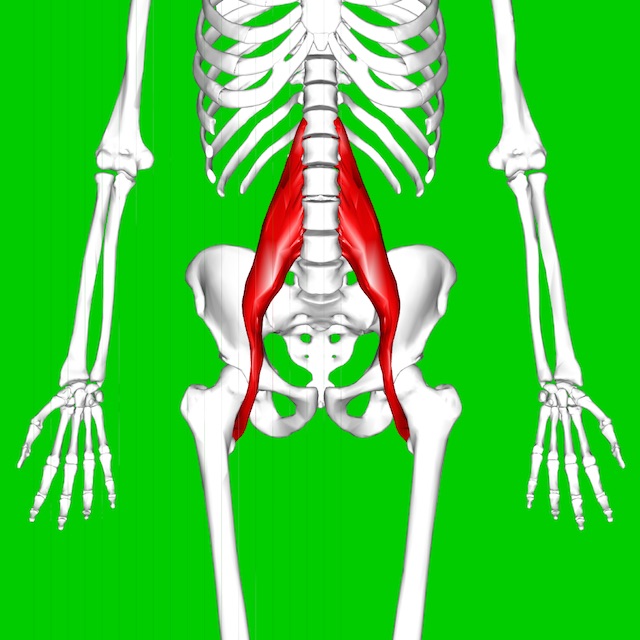
The psoas runs from the T12-L5 transverse processes (the sides of the spine in your lower back) and inserts into a little bony protuberance on your upper, inner thigh called the lesser trochanter.
First and foremost, due to all its attachments, the psoas is a spinal stabilizer. Should it become weak, other muscles around the spine must grip to stabilize. For some of them, this is their job, and for others, they are simply picking up the slack. This is the foundation of what we call compensation.
Its second action is that of being a strong hip flexor. It is involved in walking, running, propulsion, and being able to lift your leg in the air and get your knee to your chest.
For someone who has tight hamstrings and stretches them all the time with only marginal results, the psoas may be part of the answer. But, it may not be what you think.
As you’ve seen from what I wrote above, the psoas is actually quite prone to weakness and inhibition. If you want to do a basic check for yourself, lie on your back and hold your leg in the air (if you cannot bring your leg near 90 degrees, keep the knee slightly bent and bring it as high as you can). You should be able to hold it up there for a minute or longer without strain. If you find that this is very difficult, there is a chance you don’t need to stretch your psoas, but you may need to strengthen it!
Most recently, I had a woman who hurt her back doing a lunge in a yoga class. She has had nerve pain down her leg ever since and her physical therapist had her stretching her psoas to find relief. It wasn’t working. Of course not! A lunge actually stretches the psoas, and that’s how she got hurt!
She had compressed a nerve in her back doing the lunge, over-stretched her psoas, and was having trouble finding stability. It took one session to fix. I released the compression, got the non-functional psoas to work, and brought stability back to her spine. At the end of the session, she was crying, had no nerve pain down her leg, and called me a week later in gratitude as the pain never came back! Imagine if she had kept stretching her psoas and that she was even told that her pain was emotional. 
Our minds and our bodies are connected. There are few people out there who will refute that. When we bring our intelligence to an area that the consciousness previously did not penetrate, we increase the quality of our lives, both in terms of mobility and mental health.
To state, however, that one muscle, particularly the psoas, is the kingpin of our emotional distress and physical suffering is simply untrue. And then to say that stretching it is the eternal gateway to making it healthy and functional is simply uneducated.
All of our muscles are the muscles of our soul. When awareness awakens, we awaken.