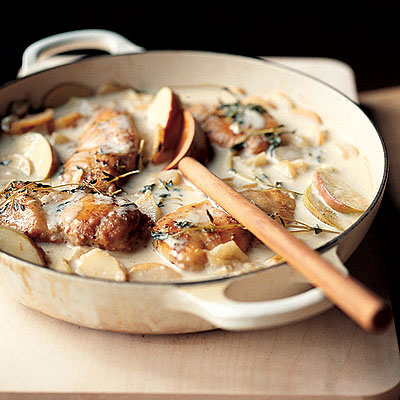
Chicken is simmered in a cider and apple sauce with potatoes to give it a real autumnal flavour. Serve with shredded greens or broccoli.
Preparation time:10 minutes
Cooking time:25 minutes
Total time:35 minutes
Serves: 4
Ingredients
500g pack Waitrose Fresh Chicken Breast Fillets
1 tbsp plain flour, seasoned
1 tbsp olive oil
500ml bottle Waitrose Vintage English Cider
½ x 500g pack baby new potatoes, thickly sliced
1 medium Bramley apple, peeled, cored and chopped
½ x 15g pack fresh thyme
200ml tub Waitrose Half Fat crème fraîche
1 Cox eating apple, sliced into 16 pieces
Method
Coat the chicken in the seasoned flour. In a large frying pan with a tight-fitting lid, heat the oil then brown the chicken on both sides for 2-3 minutes.
Pour in the cider and add the potatoes. Bring to the boil then add the chopped Bramley apple and thyme. Season well, cover and simmer for 20-25 minutes, until the potatoes are tender and the chicken is thoroughly cooked with no pink meat.
Stir in the crème fraîche and Cox apple slices and simmer uncovered for 5 minutes until the apples are just tender. Try This Replace the chicken breast fillets with 4 pork loin steaks.
Variation
Replace the chicken breast fillets with 4 pork loin steaks.
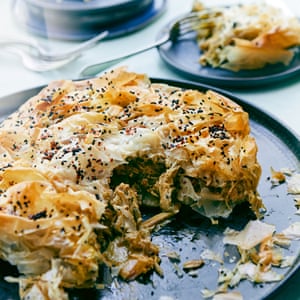
This is a wow of a pie. Serve it with a crisp green salad and some pickles.
The chicken can be made a day or two ahead of assembling the pie. Keep it in the fridge and just bring it back to room temperature before putting the dish together.
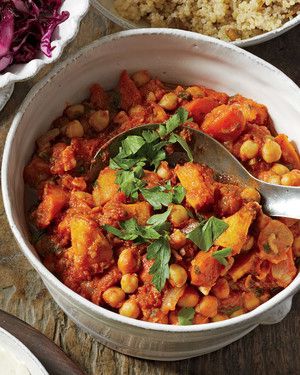
You can also just make the chicken part of the dish. It makes a delicious stew, served with steamed rice or piled into a pita or wrap. If you do this, keep the tahini sauce: it’s always a welcome addition.
Serves 6
chicken thighs 750g, boneless and skinless garlic 4 cloves, crushed ginger 2cm piece, peeled and finely grated (15g) ground cumin 2 tsp ground coriander 2 tsp smoked paprika ¾ tsp ground turmeric ½ tsp ground cinnamon ¾ tsp ground cloves ⅛ tsp olive oil 90ml, plus extra for greasing cider vinegar 3 tbsp salt and black pepper baking potatoes 2 (450g), unpeeled and cut into ½cm thick rounds unsalted butter 45g onion 1, thinly sliced (150g) chicken stock 200ml parsley leaves 5g, roughly chopped coriander leaves 5g, roughly chopped filo 8 sheets (30cm x 38cm) nigella seeds 1 tsp Aleppo chilli flakes ¾ tsp (or ⅓ tsp regular chilli flakes)
For the tahini saucetahini 50g Greek yogurt 80g garlic 2 cloves, crushed lemon juice 1 tbsp salt and black pepper
Put the chicken into a large bowl with the garlic, ginger, ground spices, 1 tablespoon of oil, 2 tablespoons of vinegar, 1 teaspoon of salt and a generous grind of black pepper. Mix to combine, then leave to marinate for at least half an hour (or overnight in the fridge).
Preheat the oven to 180C fan/gas mark 6.
Mix the potatoes with 1½ tablespoons of oil, ¾ teaspoon of salt and a good grind of black pepper. Transfer to a parchment-lined baking tray and spread out so that they are not overlapping. Bake for 20 minutes, then increase the oven temperature to 220C fan/gas mark 9. Remove the tray from the oven, carefully flip over each potato slice, then return to the oven for another 10 minutes, or until golden. Remove from the oven and set aside until needed.
Advertisement
Reduce the oven temperature to 180C fan/gas mark 6 again (or turn the oven off for now and preheat before baking).
Put 15g of butter and 1½ tablespoons of oil into a large sauté pan and place on a medium-high heat. Once hot, add the onion and cook for 5 minutes, stirring occasionally, until softened. Add the chicken and cook for about 10 minutes, until lightly brown, then add the stock, ¼ teaspoon of salt and a good grind of black pepper. Bring to the boil, then lower the heat to medium. Simmer gently for 25 minutes, or until the chicken is just cooked through. Increase the heat to medium-high and continue to cook for about 8 minutes, or until the liquid has thickened and reduced to about 4 tablespoons. Remove from the heat and leave to cool for about 10 minutes, then use two forks to shred the chicken into large chunks. Stir in the herbs and set aside.
To make the tahini sauce, put the tahini, yogurt, garlic, lemon juice, ⅛ teaspoon of salt and 2 tablespoons of water into a bowl. Whisk together until smooth, then set aside.
Melt the remaining 30g of butter and combine with the remaining 2 tablespoons of oil. Line the base of a 23cm springform cake tin with baking parchment and lightly grease the sides with the butter mixture. Lay a sheet of filo out on a clean work surface and brush with the butter. Transfer this to the tin so that the base is covered and the filo rises up and over the tin’s sides. Repeat with the next sheet of filo, brushing it first with butter, then arranging it in the tin, rotating it slightly so that the excess hangs at a different angle. Continue in this fashion, brushing each piece generously as you go, until you have used up 6 pieces of filo in total and the base and sides are all covered.
Next, add the potato slices, overlapping slightly, so that the base of the pie is completely covered. Top with the chicken mixture and gently push down to even out. Lastly, spoon over the tahini sauce, spreading it gently to coat the chicken layer. Brush a piece of filo with butter and fold it in half horizontally,like a book. Place this over the tahini layer, tucking in the filo around the filling. Brush the top with the butter mixture, then repeat with the last piece of filo, angling it to cover any exposed areas. Now fold over the overhang, crinkling up the filo to create a nice crumpled effect on the top. Brush the top with the remaining butter, sprinkle with the nigella seeds, place on a tray and bake
Nigella Lawson in London N1.Photograph: Pål Hansen for Observer Food Monthly
You once said, “I feel that everything I want to say about life, I can say through food.” Could you elaborate on what you wanted to say – with both your food writing and TV shows? Because I have a very personal way of writing, writing or talking about food is a way of keeping a diary. My first book, How to Eat, written when my children were babies, has a chapter on weaning, for example; Feastincludes a chapter on Teen Feasts.
I have always believed that what is true in the kitchen is also true out of the kitchen (and, indeed vice versa). In other words, cooking is a metaphor for life. When you cook, you need structure and an understanding and acceptance of the rules that actually matter, but just as importantly you need to be able to loosen up and go with the flow.
If you want to cook well, you must not strive for perfection but, rather, acknowledge your mistakes and work out how you can rectify them: it is in rectifying your mistakes that you actually go on to make something you’re happy with, that is really your own. I firmly believe that although the “point” of cooking lies in the end result, its meaning resides in the process.
So, in life, you have to concentrate in the present, rather than fretting about the past or worrying about the future. Easier said than done (believe me) but cooking helps you learn that.
I know this is not true for everyone, but I feel that cooking is a way of strengthening oneself: not being able to feed oneself to me feels like a state of victimhood; being able to sustain oneself is the skill of the survivor. And I am no victim, but very much a survivor! Everyone should be, or make sure they become one.
You’ve talked a lot about your food being “messy” – the word seem to have very positive connotations for you. Why is messy a good thing, in a food context? And in general? Well, I promise you, my kitchen doesn’t look as if Lucille Ball’s been lurching from one comedy culinary catastrophe to another. I am messy, but not in the sense that I leave a trail of devastation behind me as I cook. No one can cook well – or rather comfortably – out of chaos. It affects the mind, one’s sense of wellbeing, and stops you from being able to react quickly in the kitchen.
But I’m certainly clumsy: I can’t chop neatly or with virtuoso rapidity; I spill things (though wipe them up); knock things over (but pick them up); and generally when I cook, every day, I don’t have a strategy or a recipe, I just grab what I want or simply happen to have in the house, tear herbs messily by hand, lose myself in the minute and anyone watching would think I have no idea of what I’m cooking. I do have an idea, it’s just an idea that can change as I taste, and any strategy or plan only cramps and confines me. I’m no good at authority, even my own.
As for how the food looks when I cook it, yes, it’s messy, but for me messiness is beautiful. I can’t stand a manicured plate, a thoughtfully placed arrangement, form over content, concept over taste. I want everything to tumble out in the bowl and just be resplendent and welcoming as it is. Perhaps messiness is not quite the right term for my approach: “haphazard” may sum it up more neatly.
Six-year-old Nigella, left, at home with her father Nigel, mother Vanessa and sister Thomasina in 1965.Photograph: Knoote/Daily Mail /REX
What’s more important, and why – cooking a dish “correctly” or just making it delicious? I’m not sure I’d be able to cook a dish “correctly”. Greed and impatience may not be considered virtues, but they certainly help me write a recipe and cook. Whenever I start cooking, or I read a recipe, my mind filters out complicated processes and what I think are unnecessary steps. Often this is simply to do with reducing the washing up. But I also want to get to the flavours faster. For me how food tastes is always the most important thing. How I get there, doesn’t worry me.
But we all have different temperaments and can be happy cooking only in ways that suit that temperament. People who, when they have a train to catch, need to be at the station more or less as the train is pulling out of the platform will have a quite different cooking style than those who feel happy only if they get there a good hour or two in advance.
You first started cooking for people in earnest in your second year at university. Tell us about those early dinner parties – what was on the menu? Well, I didn’t have much money, so I used to go to the Covered Market in Oxford and buy huge sackfuls of onions. I was the uncrowned queen of onion soup.
I’d go into everyone’s room in my house-share and pick through whatever alcohol they had – miniature bottles of Bénédictine, cider, Bulgarian wine – and splosh that in as I cooked. And there was always stale bread and cheese past its best in our communal kitchen to make an oozy croute or two to go on top. I also used to buy extremely cheap cuts of meat. I could get a lamb breast for 25p (now you can’t even buy them as they’re all sold for kebabs) and would cook it low and slow with gorgeous whole spices in our bad-tempered oven.
Obviously, slow cooking is a wonderful thing for a student, as it more gratifyingly postpones the moment of essay writing. Or, once I’d started writing, the smells wafting through the house would ease the pressure of the stressay.
With fellow Taste judges Ludo Lefebvre and Anthony Bourdain.Photograph: Ray Burmiston
When you write, do you have a particular reader or readers in mind? How much is the writing a conversation with that person? When I started writing about food, I certainly had my sister Thomasina (who died at 31 in 1993) in mind. I was continuing a conversation about food that we’d had daily when she was alive. But then, How To Eat had a more narrative way of giving recipes (I’ve never entirely lost that) as well as being a way of memorialising her and my mother’s food; she too had died young.
But I suppose I was also writing for myself, as cooking and enjoying food is a way of accepting and celebrating being alive, which can be hard when those you love have died. Call it survivor’s guilt, or simply an etiolated ability to take pleasure in life, a reduced sense of self, but whatever, cooking and writing about food restored me to life, and still does.
When I started on my second book, I had a certain friend in mind who’d been brought up by her mother to have a disdain for cooking, and I felt her confidence had been so diminished by that. She never felt at home in her own kitchen. So in my mind – not exactly consciously – was a desire to show her how easy cooking could be – and, frankly, it’s only as complicated as you want it to be – and what pleasure it could give. I suppose that motivation has been present in all my books. Another friend of mine said to me once after I’d given him one of my books: “You get me into the kitchen before I’ve had time to be frightened of being there.”
That’s what I want, and why my recipes – even for the simplest dishes – are often so long and chatty and adjectivally exuberant (sometimes to the point of no return).
How do those conversations differ when they take place through TV? From my point of view, they don’t, but I never watch my programmes. Certainly, I feel that I have an intimate style of talking and have been made aware that can be construed as coquettishness. But believe me, I have nothing of the coquette about me.
And when I’m told that I am full of innuendo, I am mystified. I am the least salacious person. I don’t know if that misconception is because women are still meant to be like Scarlett O’Hara, and pick like a bird, and that somehow seeing a woman enjoy food and having an appetite is regarded as wanton lasciviousness in itself. I’m not complaining. Food is sensual
But the conversation is still me, intimate and – like my cooking style – somewhat haphazard, as I am never scripted. And maybe I do sometimes go over the top: I have a nervous need to fill the silence (on screen and off) but I’m working on it!
What’s the very first thing you remember eating? Oh, I was a terrible eater as a child. Hated it. Or, rather, hated mealtimes, so most of my memories are of being presented with a plate of cold, uneaten food from a previous meal (I was brought up old-school) and I wouldn’t describe that as eating, so much as suffering, food.
But I do remember being a very young child, with my grandmother in Brighton during a record-breaking heatwave of a summer, asking – when we dived into a cafe to take refuge from the sun – for buttered spinach and hot chocolate. What heaven that was! At the time, I didn’t understand why she felt it to be so amusing. Was rather affronted, actually.
On the set of Nigella Bites in 1999. Channel 4
What was the last thing you cooked for someone else, and why? I’m filming in LA for a month and, inconceivable though this might seem, after a while, room service begins to pall, quite apart from being ruinously expensive. What’s more, I just don’t feel like me when I don’t cook.
I have a kitchenette in my room (what pleasure it gives me just to say the word “kitchenette”) and I made me and a friend some roast sweet potatoes and tequila-and-lime-marinated chicken. I could have cooked it better with proper equipment and in my own oven, but I wasn’t after perfection but good, home food. And got it. But yes, the smoke alarm did go off.
What was the last thing you cooked that didn’t quite turn out as planned? Actually, a lot of my favourite recipes have come about as a consequence of rectifying some mistake or other, so I’m not automatically dismayed at things going wrong. But I’ve been trying to make a form of grapefruit drizzle cake, and I just can’t get it right. When you make a lemon drizzle cake, it’s the zest that makes the cake lemony, the juice just provides that divinely squeaky sourness. But grapefruit zest is just disgusting, and doesn’t seem to have anything of grapefruit flavour, just its bitterness. I’ve tried it twice, without wholehearted success. I have a three-strikes-and-you’re-out rule, so if I don’t get it right next time, I’m kissing this particular idea goodbye.
The Great British Bake Off – how far would you get? I don’t even think I’d pass the audition stage. I love baking, and I bake a lot, and I love what I do bake, but just the words “uniformity of size and shape” make me quake.
I am not in the slightest bit insecure about what I can bake, and I’m so very happy doing it, but shop-bought perfection is way beyond me. But I’m perfectly content with that, and with the ramshackle homemade-ness of my creations.
Interview conducted via email between London and Los Angeles;@Nigella_Lawson
Wednesday, 29 May 2013
Meet two barking blondes: How love of dogs changed our lives
SITTING in the decadent lounge of a swanky, five-star hotel in Kensington, west London, four girlfriends are enjoying afternoon tea. It’s a twice-monthly chin wag for Anna, Jo, Molly and Matilda and sounds like a perfectly normal get together befitting a group of close friends, except that two of the girls are of the four-legged variety. Molly is a miniature bull terrier, Matilda a bulldog and Anna Webb, 47, and Jo Good, 53, are their respective pooch obsessed owners.
Molly the minature bull terrier shares none of man's bad habits
The two women have previously co-presented the world’s only radio show dedicated to dogs – BBC London’s Barking At The Moon – that attracted canine-loving celebrities including singer Bryan Adams and football manager Harry Redknapp to the airwaves.
They are also proof that a dog isn’t just man’s best friend but a woman’s too. Both admit they treat their pooches like the children they chose never to have and put them before any men in their lives.
“Anna and I met by chance in a dog-friendly café in Hyde Park almost five years ago and hit it off because we shared the same opinions on everything from our clothes and musical tastes to our dismissal of men and our absolute adoration of dogs,” says Jo, who lives with Matilda in Maida Vale.
“People look at us with a sigh because our dogs come first, careers second, fashion third, getting our roots done fourth. We’re ridiculous and we know it. As for men, dogs are so much better. Everything’s about food with dogs, while with men it’s all about sex. Dogs don’t bear malice or sulk or leave their clothes, books and musical instruments strewn across the floor.”
Though she laughs as she says this, there’s sadness behind Jo’s words because her partner of five years – affectionately known as Big George due to his height – died suddenly from heart failure in April 2011. The pair had raised Matilda as if she were their daughter.
“Matilda will be five in August and I never want anything to happen to her because she’s my last link with George,” says Jo. “Matilda made us a family and has been my saviour since he died. We didn’t have children so she’s all I have left of him.”
Meanwhile Anna chose to leave her own long-term partner when her pooch Molly was 10 months old and he could no longer cope with playing second fiddle.
“We’d been together five years but after getting Molly when she was eight weeks old she became the centre of my universe,” admits Anna, who lives in Islington, north London and is a broadcaster and dog expert. “I’d refuse to go to the pub or out for dinner with him if it meant leaving Molly. I didn’t want to be without her.”
According to the Oxford Dictionary what Matilda and Molly have become are “furkids”, a word used to describe the increasingly common phenomenon of dogs taking on the role of surrogate children, particularly among child-free women in their 40s and 50s.
Research has revealed that women produce oxytocin when they stroke their own dog, the same happy hormone produced by new mums when they breastfeed their babies. “I always believed there was no place for a child in my life and that I’d be a terrible mother, the kind who’d forgetfully leave it standing outside the supermarket while I drove off with the weekly shop,” says Jo. “So it was one of life’s greatest surprises when I found myself longing to care for and nurture another being.
“It all started when George and I went to New York where we’d sit in Union Square which was awash with people parading their bulldogs. I couldn’t take my eyes off them. They were like fat, cuddly, docile children who wanted to be loved.
“Back home George trawled the internet to find a bulldog puppy for me. We collected Matilda when she was 10 weeks old and I cuddled her in a blanket like a newborn baby as we drove home.
“Until then I’d been the archetypal career girl with a fabulous social life of non-stop parties. George and I ate in restaurants every night and would take off on a whim to the likes of Cannes and Paris. But Matilda took over our lives and we didn’t want to go anywhere without her. We began holidaying in this country and joined the Hyde Park bulldog group where we’d stand with other owners watching proudly as the dogs played, like parents observing toddlers in a nursery.”
Jo admits that had she met Anna before she had got Matilda she’d have thought her completely nuts.
“I always joke that Anna is half dog, in the nicest possible way,” she laughs. “But now I’m just as bonkers as she is.”
As a nation we lavish £5billion every year on our dogs and as you would expect Molly and Matilda are pampered pooches in the extreme. They enjoy mud wraps and pedicures at a pet spa in Harrods and have back massages from a canine chiropractor once a month.
They have holidayed in Paris, at the plush Four Seasons Hotel in Hampshire where there are menus just for dogs, and at the picturesque Bailiffscourt in West Sussex where staff bring bedtime biscuits for four-legged guests.
If you think that’s barking their dogs’ diet is more ridiculous. Molly and Matilda dine on cider vinegar with royal jelly to make their coats shine, organic fruit and veg, smoked salmon and minced chicken – everything they eat is raw because research has shown this could increase their life span by up to three years.
Dog enthusiast Bryan Adams is a fan of BBC London's Barking At The Moon
I always joke that Anna is half dog, in the nicest possible way...but now I’m just as bonkers as she is
Jo Good, presenter
The dogs each sleep in sumptuous beds (at £245 apiece) with handwoven blankets, wear rhinestone collars costing up to £300 each and both have extensive wardrobes – Matilda’s includes a pink tutu and a handstitched lime green cable knit jumper.
While Jo was a latecomer to this canine parallel universe Anna reveals that her obsession with dogs began as a child growing up with springer spaniels at home. “I spent a lot of time with my aunt who was well connected in the dog world and the highlight of my year was going to Crufts,” she explains.
“However as a busy career girl I hadn’t had a dog for years until my dad died 11 years ago and, bereft, I decided to get Molly.
“I soon discovered she offered companionship that my then partner and no man ever could. It’s been scientifically proven that dogs can read our facial expressions the way humans do and can smell when you’re sad or happy. They’re intuitive and sensitive, unlike men.
“Obviously there are certain things you get from a relationship with a man that you don’t get from a dog – I certainly miss sex sometimes! However with Molly I can wake up with greasy hair and spots on my chin and it doesn’t matter.”
Anna and Jo both admit that despite never having wanted children, they do now appreciate the maternal urge that passed them by in their 20s and 30s.
Jo says: “Only now through my relationship with Matilda and the way she loves and needs me do I understand the maternal instinct between humans and their children. I do think that had I understood this in my 30s I would probably have wanted children.
“The actress Jenny Seagrove once told me that when your dog reaches four they will never leave your side. It’s true. Matilda is my soul mate. I think she sensed that when George died. For a year I couldn’t say his name and would spell it out if talking about him otherwise Matilda would run to the door thinking he must be there.
“You’d be forgiven for thinking I’m barking mad and I probably am but Matilda came into my life and changed everything, not least my capacity to love another being. She and Molly have also taught Anna and me that life without a man can be fulfilling, loving, fabulous and the most barking mad, bonkers fun imaginable.”